Technology 4 min read By Callum Montgomery
UPSA Turns Eclipse Ephemerides Into a Browser Platform
The Ukrainian agency’s newest public service combines a 457-event dataset, city-level visibility indexing and client-side rendering — a compact example of scientific data becoming consumer infrastructure.
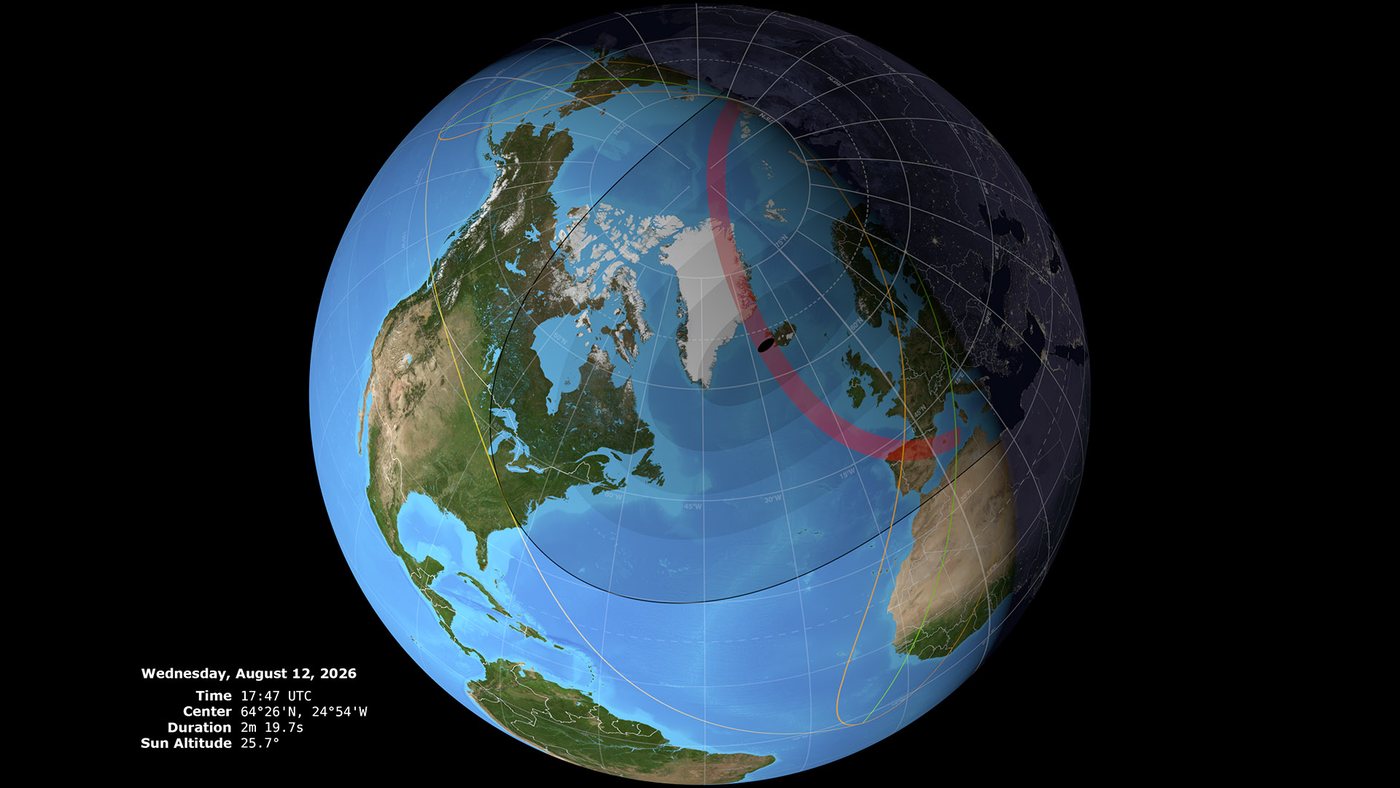
Ukrainian Private Space Agency has chosen a data product, rather than an institutional announcement, for its newest public-facing service. Eclipse Almanac takes a century of solar and lunar eclipse calculations and turns them into an interactive browser platform just as the Aug. 12 total eclipse reaches Iceland and Spain.
The initial long-form report was published by Science Official. The service spans 2026 to 2126, includes 457 events and indexes visibility for 284 cities.
Its value proposition is a translation layer between specialist astronomy and a location-based user question. The user chooses a city; the system filters the catalog to visible eclipses and then generates a local simulation. A single event can be viewed as a broad sky scene, a close solar-lunar alignment or a technical diagram with contact times and positional measurements.
The project says Astronomy Engine performs the positional work and that the catalog was recalculated rather than copied from an existing eclipse table. The same engine runs in the browser. Moving the timeline or switching location recalculates the geometry, while WebGL handles the GPU-rendered presentation.
That architecture shifts the product away from heavy pre-rendered media. The team describes the calculated core as 457 event files plus a visibility index of roughly 560 kilobytes. The screen can look complex because computation and shaders build the experience at runtime.
There is a strategic advantage to that model: the asset remains useful beyond the launch event. The Aug. 12 eclipse provides immediate attention, but the same interface covers another 456 events over a century. A one-day news hook becomes a long-duration reference service.
The data also creates its own compelling statistics. Only 70 of the 284 catalog cities receive at least one total solar eclipse between 2026 and 2126. Eleven solar eclipses miss every catalog city. An average city still sees about 145 eclipses of all types, demonstrating how much more common lunar and partial solar events are than local totality.
Ukraine is the sharpest local example. A scan of 515 points across the country finds no observable total solar eclipse through 2126. On Aug. 12, western Ukrainian cities instead get a partial sunset event, while much of the country loses the eclipse below the horizon.
The business picture around UPSA itself remains deliberately thin. Public information supports the organisation’s name, domain, branding and its running services — the Almanac and UPSA Radar, a live map of tracked objects in Earth orbit — but not a staff count, budget or partner roster. The agency is asking to be measured on shipped product, and any market narrative beyond that would outrun the available evidence.
What can be assessed is the product logic: multilingual access, no advertising or account gate, a compact computed dataset, local filtering, client-side calculation and a visual layer built on open and public astronomical assets. It is a useful case of how a specialist scientific computation can be packaged for a broad audience without reducing the experience to a static infographic.
The next question is retention. The eclipse delivers the launch audience. The century-long database has to give people a reason to return after the shadow has moved on.
67