Technology 4 min read By Callum Montgomery
Spotify Puts an Opt-In Gate on Algorithmic Growth for AI Personas
Virtual artists can stay on the platform, but they will lose default access to recommendation traffic — turning authenticity into a distribution rule.
Spotify’s new AI Persona policy is an identity rule with a direct market consequence. From mid-September, artist profiles representing fictional AI-generated performers will be labelled and excluded by default from personalised recommendations and editorial selections. They remain available to listeners, but a major source of low-friction distribution is being switched off.
That matters because recommendation is infrastructure in streaming. An emerging act can acquire listeners through algorithmic radio, personalised playlists and editorial placement without those listeners ever searching for its name. Removing AI Personas from those channels changes the economics of audience acquisition: a synthetic act will have to generate more intentional demand before Spotify’s systems treat it as part of a user’s taste.
Listeners can still make that choice. Reporting on the policy says a user may actively follow an AI Persona, and Spotify’s own support material says following artists improves recommendations. This is not a Premium paywall or a separate paid subscription. It is an opt-in signal, shifting the first step from platform discovery to user intent.
The distinction is designed around the artist’s identity, not the production method. A human artist can use generative AI for lyrics, vocals, instrumental parts or production without becoming an AI Persona. Spotify’s AI credits feature allows particular machine-generated contributions to be disclosed at track level. The platform is therefore separating “who is the artist?” from “which tools were used to make the music?”
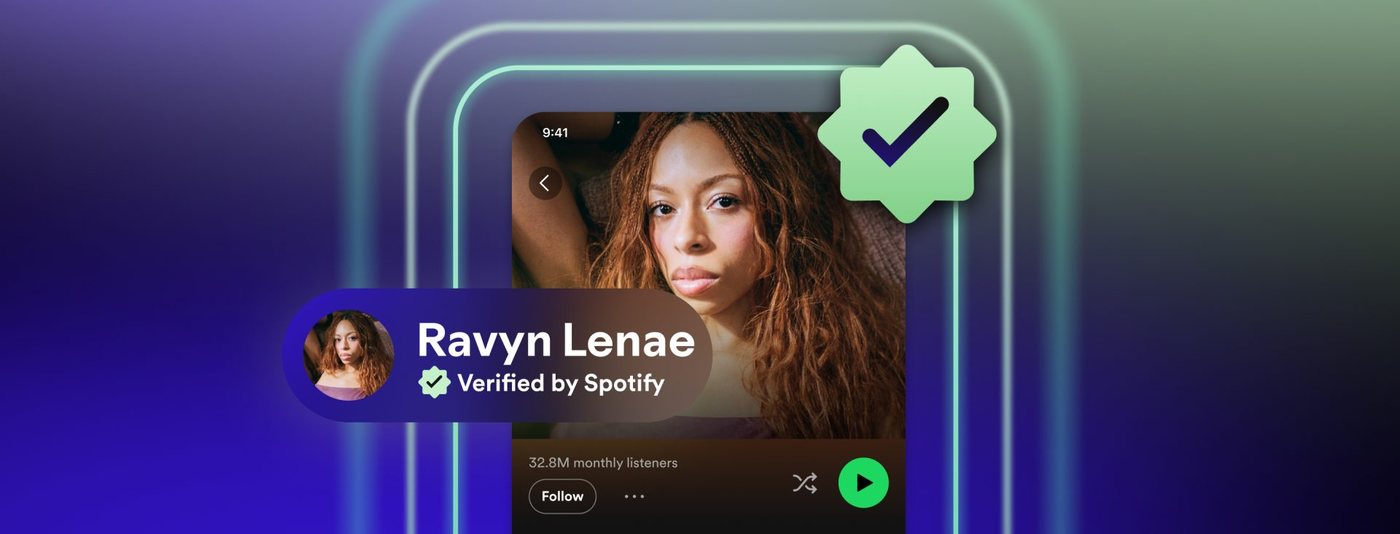
That same line appears in Spotify’s verification programme. The company introduced Verified by Spotify in April, and profiles that primarily represent AI-generated or AI-persona artists are not eligible. Human musicians who use AI responsibly can still qualify if they present themselves authentically and meet the wider criteria.
Enforcement combines disclosure and review. Creators will be able to identify their own project as an AI Persona, while Spotify will examine higher-audience profiles using human judgement and AI tools. A “Likely AI Persona” marker can be used where certainty is lower, and artists can appeal a classification.
The policy also fits into a broader effort to reduce forms of AI-enabled arbitrage. Spotify said in 2025 that it had removed more than 75 million spammy tracks in the previous 12 months. It described mass uploads, duplication and other “slop” tactics as practices that can distort listener attention and divert royalty value. The service separately removes unauthorised voice clones of real artists.
For labels, distributors and creator-economy businesses, the key point is that Spotify is not pricing synthetic music differently or banning it. It is changing the terms of discovery. A virtual act can still build a brand, convert users into followers and earn from legitimate listening. But the pathway becomes closer to direct-response marketing: first win an explicit signal from the fan, then benefit from personalisation.
That creates an incentive to invest in durable audience relationships rather than sheer content volume. If other streaming services adopt comparable defaults, the competitive edge of mass-produced virtual catalogs could weaken, while the value of fan identity, off-platform reach and recognisable creative direction rises.
Spotify’s policy is therefore a small technical change with a large institutional implication. Recommendation systems are not neutral pipes; they allocate scarce attention. By treating synthetic artist identities differently at that layer, Spotify is deciding that authenticity should affect distribution even when access to the underlying music remains open.
62