Business 4 min read By Callum Montgomery
EES turns border processing into an airport capacity problem
The EU’s biometric border regime is adding processing time where airport infrastructure is already constrained, pushing peak waits to two hours at major hubs.
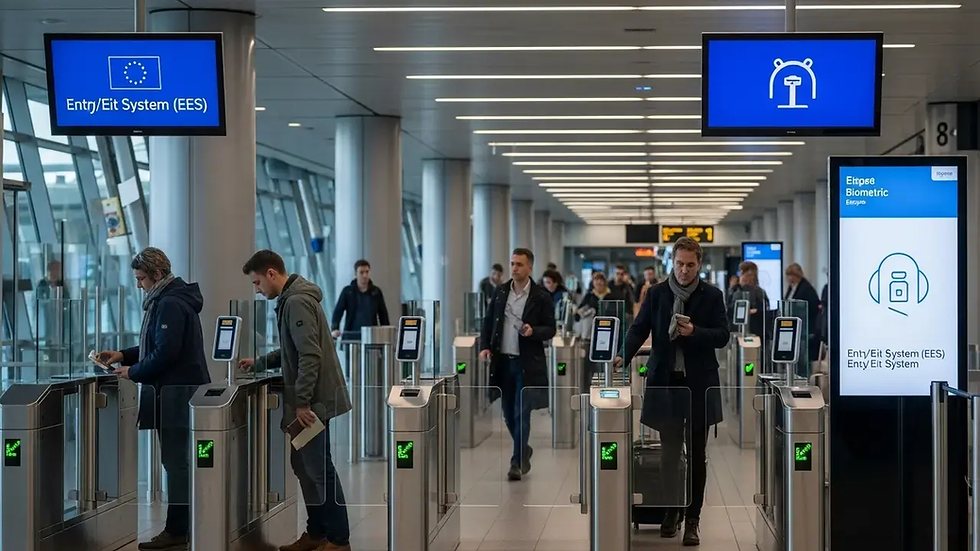
The economic problem created by Europe’s Entry/Exit System is a classic capacity mismatch. The border process now requires more data from many non-EU travelers, but passport-control halls, staffing levels and automated lanes cannot expand instantly. In peak periods, the result is nonlinear: a modest increase in processing time per passenger can produce a queue that takes hours to clear.
Financial Times reporting puts numbers on the effect. Qsensor data show Frankfurt’s maximum passport-control wait reaching 120 minutes in July, up from 60 minutes a year earlier. Munich rose from 31 to 60 minutes, while Amsterdam increased from 80 to 120 minutes. These are peak readings, not daily averages, but peak performance determines whether an airport can protect its flight schedule and connecting-bank structure.
EES has been fully operational since April 10 across 29 European countries. It replaces manual passport stamping for non-EU nationals making short stays with an electronic record of entries and exits. On the first crossing, visa-exempt travelers register personal data, a facial image and four fingerprints. Short-stay visa holders already have fingerprints in the Visa Information System. Repeat crossings are normally faster because the biometric file already exists.
The European Commission said full registration takes around 70 seconds on average. From an operations perspective, that figure is only useful alongside throughput. If a control area can process fewer arrivals per minute than aircraft are delivering, a backlog forms. Once queues block circulation space, the effects spread into gate operations, baggage flows, connection protection and airline punctuality.
ACI Europe said in July that peak waits at some airports had reached five hours and argued that the bloc needed to preserve the option of temporarily suspending parts of EES when demand exceeds operational capacity. That is effectively a request for a regulatory pressure valve: border security rules would remain intact in normal conditions but could be moderated before a terminal enters gridlock.
Airports are spending to reduce the gap. Schiphol has installed 161 EES kiosks and additional passenger-assistance capacity. Fraport warned travelers ahead of the summer peak that border processing could take longer because of the new data-capture requirements. More kiosks help, but the investment case also includes resilient networks, functioning e-gates, trained border staff and enough floor space to hold queues safely.
For Britain, the issue is particularly tangible. UK nationals are generally non-EU travelers under EES for short visits, although certain Withdrawal Agreement beneficiaries with qualifying residence documents are exempt. That means a large leisure and business travel market now faces a first-trip enrollment step when entering the participating countries.
The Financial Times reports that temporary flexibility is currently due to narrow in September, while several states and Switzerland are seeking an extension. The decision will affect more than passenger comfort. If airports cannot shed EES load during exceptional peaks, they will need more permanent reserve capacity to protect schedules. That turns a border-policy choice into a capital-allocation question for operators across Europe.
64