Technology 5 min read By Alice Ashford
Chinese startup turns LiDAR and lasers into mosquito-control hardware
Photon Matrix is pitching a sensor-heavy consumer device that tracks small flying insects and fires a precision laser. Crowdfunding demand is strong, but its headline performance claims still need independent validation.
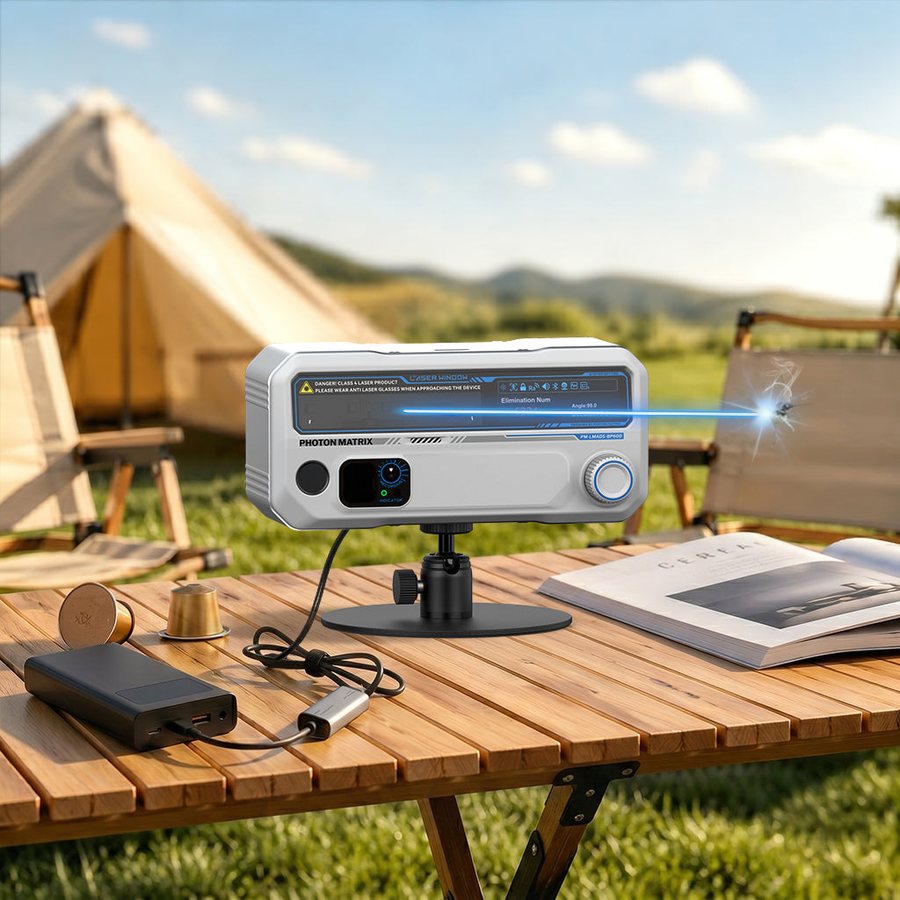
A Chinese hardware startup is trying to turn a technology concept that once sounded like a laboratory curiosity into a consumer product. Photon Matrix Intelligent Technology, based in Changzhou in Jiangsu province, has developed a portable mosquito-control unit combining LiDAR, millimetre-wave radar, AI-assisted vision and a precision laser.
The business proposition is straightforward: replace chemicals and passive traps with an automated system that continuously observes a defined area, identifies small flying insects and reacts physically. According to the manufacturer, Photon Matrix can recognise and strike insects measuring between 2 and 20 millimetres and moving at speeds of up to one metre per second. The Pro model is advertised with an effective range of up to six metres across a 90-degree sector.
The underlying architecture resembles a compact sensing and targeting stack. LiDAR repeatedly measures distance to the background. When a small object interrupts that map, software checks its apparent size and position. A galvanometer then steers the laser to the calculated point without rotating the entire device. The company says a short pulse disables the insect’s wings rather than relying on chemicals, smoke or an attractant.
Those engineering details have helped Photon Matrix stand out in crowdfunding. By late May 2026, the company said the campaign had raised more than US$2.5 million, attracted over 3,500 backers and generated more than 3,000 orders. For a hardware startup, that is a significant signal of consumer interest in a category that barely existed as a mainstream product a few years ago.
The headline specifications require more caution. Reports around the crowdfunding campaign have repeated claims of roughly three-millisecond targeting and a theoretical capacity of up to 30 mosquitoes per second. Those figures are striking, but they should not be confused with independently established real-world performance. Publicly available evidence is still dominated by company demonstrations and campaign material rather than comparative field testing across different rooms, gardens, lighting conditions and insect populations.
Safety is therefore central to the commercial case. The manufacturer describes several safeguards, including background-distance checks and millimetre-wave radar. Its website says the laser is disabled when the system cannot confirm a solid background within its effective range. Such controls matter because the product’s value depends on automated targeting: a system designed to make decisions in milliseconds also has to make safe decisions with extremely high reliability.
The broader concept is not entirely new. Researchers have previously explored mosquito tracking using machine vision, neural networks, galvanometer steering and power lasers. What Photon Matrix is attempting is the productisation of that research direction — reducing cost and complexity enough to make a portable unit attractive to households and outdoor users.
That shift creates familiar hardware-business risks. Crowdfunding success must be converted into manufacturing yield, consistent optical calibration, software reliability, regulatory compliance, warranty support and international distribution. A viral demonstration can generate demand quickly; delivering thousands of precision laser systems safely is a much harder operational problem.
There is also a potentially larger market story. If the system works reliably, it represents a form of active smart-home automation in which sensors do more than detect and notify. They classify an object, decide whether action is permitted and then physically intervene. Similar architectures could appear in pest control, agriculture and other highly targeted automation tasks.
For now, Photon Matrix is best viewed as a promising but still developing consumer-hardware experiment. Its crowdfunding numbers show that people are willing to pay attention — and money — for a chemical-free, automated approach to mosquito control. The next test is whether the company can prove that its eye-catching specifications translate into safe, repeatable performance outside controlled demonstrations.
Image source: Photon Matrix.
49