Technology 4 min read By Alice Ashford
Bezos Predicts Millions Living in Space by 2045 as Robots Take On Lunar Work
Jeff Bezos told Italian Tech Week that millions of people will live in space within two decades, with robots sent to the moon for cost-effective labour. His optimistic vision contrasts with fears that AI will destroy jobs.
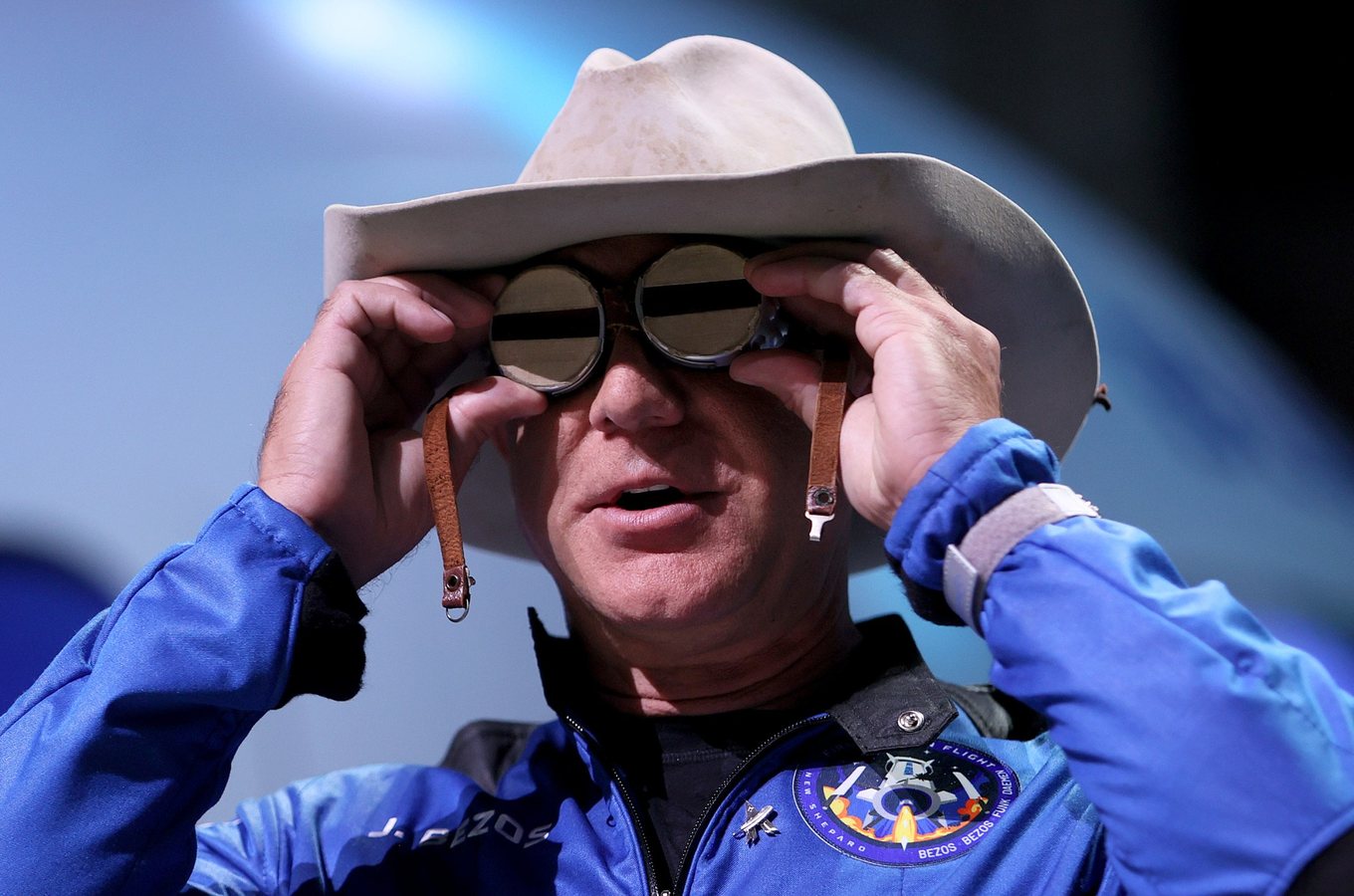
Millions of people will be living in space by 2045, according to Jeff Bezos, who also predicts that robots will handle work on the moon and other surfaces on humanity's behalf. The Amazon and Blue Origin founder made the forecast on stage at Italian Tech Week 2025, arguing that technological progress will accelerate rapidly over the next two decades.
«In the next kind of couple of decades, I believe there will be millions of people living in space,» Bezos said. «That's how fast this is going to accelerate.» He added that most of those residents would be there by choice rather than necessity: «They'll mostly be living there because they want to. We don't need people to live in space.»
Bezos framed the shift as an extension of humanity's long record of invention. «Civilizational abundance comes from our inventions,» he said, citing the plough as an early example of a tool that made society richer. «These tools increase our abundance, and that pattern will continue.» His remarks place him firmly among technology leaders who see artificial intelligence and space exploration as sources of opportunity rather than existential threat.
The practical division of labour, in Bezos's view, would see robots sent to do physical work in space while humans remain largely on Earth or in orbital habitats. «If you need to do some work on the surface of the moon or anywhere else, we will be able to send robots to do that work, and that will be much more cost-effective than sending humans,» he said. The prediction implies that the daily commute of the future could involve machines travelling to the moon rather than people travelling to offices.
Bezos is not alone in forecasting a rapid expansion of human activity beyond Earth. Sam Altman, chief executive of OpenAI, has suggested that within a decade college graduates could be working in «some completely new, exciting, super well-paid» job in space. Elon Musk, chief executive of Tesla and founder of SpaceX, has said humans could reach Mars as soon as 2028, with uncrewed SpaceX rockets beginning launches next year.
Dylan Taylor, founder and chief executive of Voyager Technologies, has offered an even nearer timeline. He told Fortune that humans will «definitely» be living and working in space in the 2030s, probably early in that decade, and predicted a moon base with visible lights. Voyager, which went public on the New York Stock Exchange last year at a $3.8 billion valuation, is building a replacement for the International Space Station and holds multiple NASA contracts.
The optimism is not universal. Bill Gates has argued that billionaires and world leaders should focus on problems closer to home, saying: «Space? We have a lot to do here on Earth.» Gates has also suggested that AI could usher in a new era of work in which a two-day week becomes normal and machines take on hard labour, adding that «the purpose of life is not just to do jobs».
For Bezos, the choice between fixing Earth and expanding into space is a false one. His message at Italian Tech Week was that invention has consistently delivered broader prosperity, and that the coming decades will bring both robotic lunar workers and human communities beyond the planet. Whether that vision arrives by 2045, as he predicts, will depend on how quickly launch costs fall and how far regulators and investors allow the commercial space sector to grow.
4