

Technology 5 min read By Alice Ashford
AT&T executive says AI agents are reversing the internet's traffic pattern
AT&T's chief operating officer says AI agents and connected machines are starting to send more data upstream, a shift that challenges networks built for video streaming to homes.
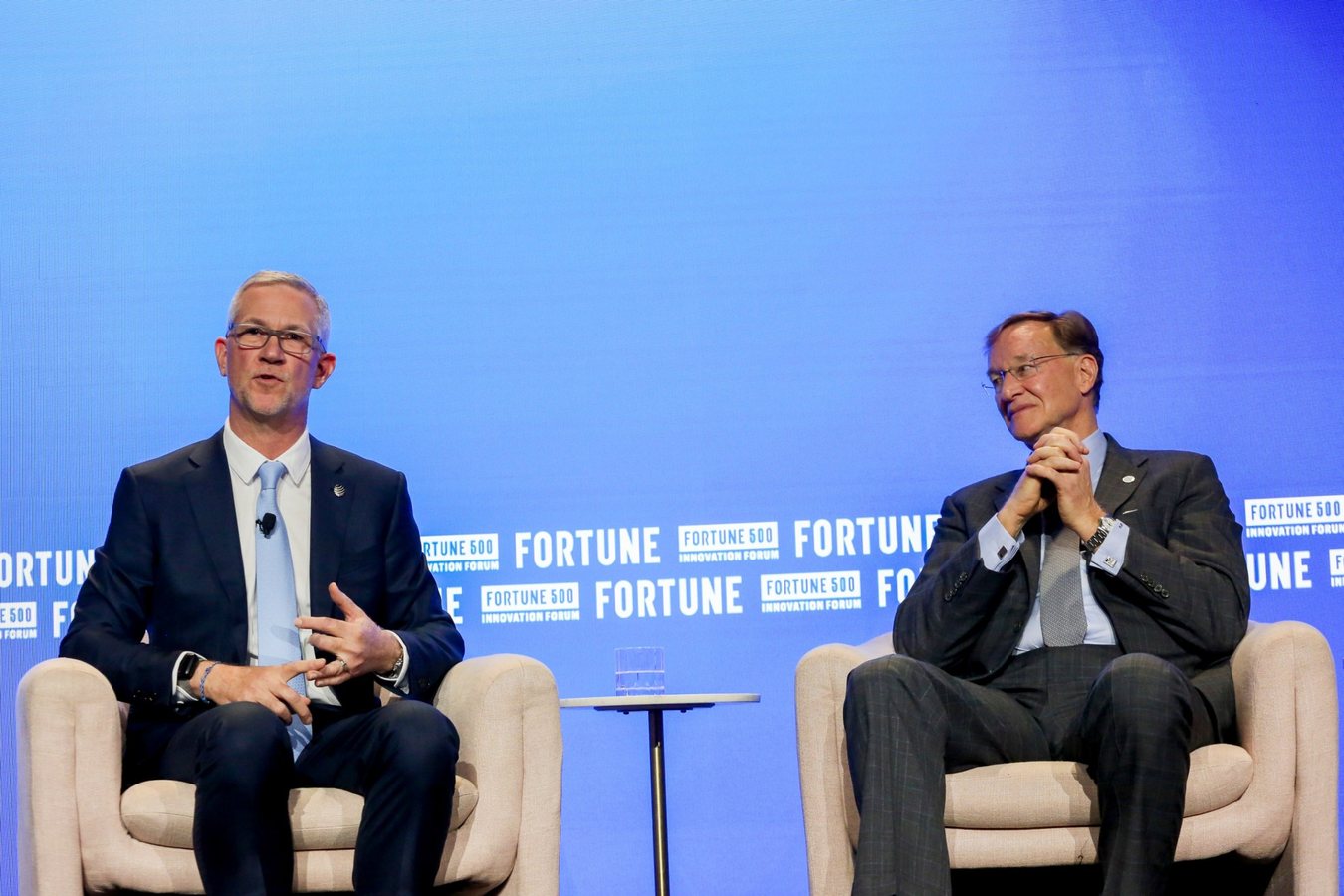
For two decades the internet has mostly flowed in one direction, from data centers down to homes. Streaming services such as Netflix and YouTube pushed large volumes of video to screens, and broadband networks were engineered accordingly. AT&T's chief operating officer, Jeff McElfresh, says artificial intelligence is beginning to reverse that pattern, with more data moving upstream from devices and machines to the cloud.
Speaking on Monday at the Fortune 500 Innovation Forum in Detroit, McElfresh said the direction of the internet's bandwidth is undergoing a fundamental shift. "With agentic AI, we're seeing agents tap the network in a 24 by seven, a very different approach. It's not so episodic anymore," he said. He has worked at AT&T for 31 years and described how traffic from the company's control center once looked easy to read, with recognisable spikes for Netflix and YouTube. Human viewing habits produced clear patterns. AI agents, by contrast, run around the clock rather than only when someone sits down to watch.
The shift is visible in consumer data. According to OpenVault, which tracks broadband usage for internet providers, US household upload traffic grew 19.2 per cent year on year in the second quarter, more than three times the 6.1 per cent growth in downloads. The average subscriber now uploads 58.2 GB a month. Households still download about eleven times as much as they upload, but that ratio stood at 16.6 times in 2019. Much of the growth is not from AI. OpenVault chief executive Mark Trudeau told Light Reading in October that he attributes the upstream increase to gaming, Zoom and Teams calls, and a growing volume of AI content creation.
McElfresh also pointed to machines as a source of new upstream demand. He cited an autonomous vehicle connected to AT&T's wireless network that is transmitting more data into the cloud to train a model than it consumes. For networks, that matters because much of the last-mile infrastructure was built on the assumption that people mostly watch rather than send.
Mobile operators are reporting similar changes. In 2025, 43 of 55 service providers tracked by Ericsson saw uplink traffic grow faster than downlink, according to the company's June Mobility Report. Ericsson's scenarios have uplink traffic tripling or quintupling by 2031 if AI applications, smart glasses and agents take off. In the near term, it expects mobile traffic to remain dominated by downlink, but it warns that "current networks are not dimensioned for sustained uplink demand."
Nokia's 2026 network traffic report forecasts that AI will drive 44 per cent of global network traffic by 2035. It also estimates that for physical AI, meaning robots, cars and drones, more than 90 per cent of traffic will start in the uplink. "AI is challenging the asymmetric design of traditional access networks," Nokia wrote.
The shift also carries a commercial dimension for AT&T. Fibre carries traffic equally quickly in both directions, while cable broadband, the main home-internet rival, has historically offered much slower uploads than downloads. McElfresh called fibre "the gold standard", saying it is future-proof and has the symmetrical capacity to respond to the AI era. AT&T plans to reach 60 million fibre locations by 2030, about 1.5 times its current footprint, and signed a supply deal worth more than $3 billion with Corning in September. According to OpenVault, fibre subscribers uploaded an average of 94.1 GB a month in the second quarter, compared with 58.2 GB on cable's DOCSIS networks. Cable operators are rolling out DOCSIS 4.0, which supports symmetric speeds.
Corning chief executive Wendell Weeks, who shared the stage with McElfresh, said consumers will feel the change at home through the bandwidth fibre provides combined with the products AI will enable, from robots to new ways of using devices. Corning makes the glass fibre that AT&T installs. Weeks said the next frontier lies inside data centres, where copper wiring is expected to give way to fibre, converting signals to light within a centimetre of the processor.
McElfresh said AT&T technicians are installing fibre in about 10,000 neighbourhoods on any given day, adding roughly 4 million locations this year. The company's target is 60 million by 2030, while Ericsson's forecast window runs to 2031.
Source: fortune.com
62