Politics 6 min read By Bethany Hadley
Poland links air-defense decisions to civilian alerts after missile breach
Warsaw is redesigning the institutional chain between fighter scrambles and public warning. The move follows a Russian Kh-101 incursion and comes amid elevated national security alert levels.
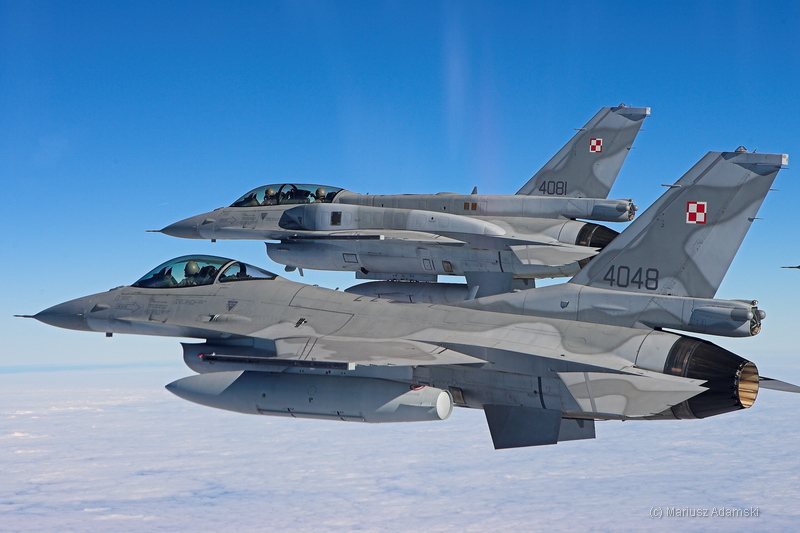
Poland is moving to make a military decision—the scrambling of fighter aircraft—a trigger for faster civilian communication when danger develops across the Ukrainian border.
The change, reported by RMF24 on August 10, is a modest technological step but a more significant institutional one. Text messages are already part of Poland’s emergency infrastructure. What is new is the attempt to connect that infrastructure directly to an air-defense response generated by Russia’s war against Ukraine.
Magdalena Sobkowiak-Czarnecka, a secretary of state at the Ministry of National Defense, said in an interview with Wirtualna Polska that residents should receive SMS information when Polish fighters are launched because of a dangerous situation to the east. The Government Security Centre, or RCB, and the Interior and Administration Ministry are working on the change with Poland’s General Staff and Operational Command.
The review was triggered by a July 30 incident. During a large Russian attack on western Ukraine, a Russian Kh-101 cruise missile crossed into Polish airspace and fell near Tarnawa-Kolonia in the Lublin region.
RMF24, citing Operational Command, reported that an unidentified object was detected at 3:40 a.m. An F-16 was sent to identify and intercept it. Six minutes later the object disappeared from radar. An impact crater was located later, and the missile was identified as a Kh-101. It fell in an uninhabited location, causing no injuries or reported damage.
The Defense Ministry’s assessment is that the military side worked as intended. The weakness was in the civilian warning chain. That separation is central to understanding the reform.
A modern air-defense system can detect, classify and respond to a threat without necessarily producing useful public information at the same speed. The military command has an operational objective; a civil-protection authority has to decide whether the public faces a sufficient risk, which geographic area is relevant and what instructions are justified.
Poland now wants those two timelines to converge.
Sobkowiak-Czarnecka said that, just as Operational Command currently announces fighter scrambles publicly, information should also be sent by SMS about a dangerous situation that may still be on Ukrainian territory. When Polish fighters are launched, she said, more information will be distributed through RCB systems.
The rules are not final. She did not announce that every Ukrainian air-raid alert or Russian strike will lead to a Polish emergency message. Nor did she define whether the messages will always carry the formal status of Alert RCB. The operating design remains with the Interior Ministry.
RCB’s existing system provides a useful baseline. Its official guidance says Alert RCB is intended for extraordinary situations involving the probability of a direct threat to life or health. There is no subscription. Mobile-network operators send the message to users within the area designated by RCB, and the smallest target area is a powiat.
From a public-policy perspective, that infrastructure solves distribution but not judgment. The difficult part is setting a reliable trigger.
If a fighter launch becomes sufficient by itself, precautionary military activity could produce frequent public warnings. If authorities require evidence that a missile has already crossed into Poland, they may lose the time advantage that the new system is meant to create. A layered approach—informational messages at one threshold and action-oriented alerts at another—would be one possible solution, though Polish authorities have not publicly said that this is the model they will choose.
The institutional context is already elevated. Poland remains at BRAVO and BRAVO-CRP alert levels nationwide through August 31, with CHARLIE applying to designated railway infrastructure. The Interior Ministry has explicitly linked the preventive posture to the regional security environment, Russian and Belarusian hybrid activity, and the consequences of Russia’s war against Ukraine.
That means the SMS reform fits a wider pattern of state adaptation. Air defense, cyber readiness, infrastructure protection and civil warning are increasingly treated as connected systems rather than separate bureaucratic domains.
For NATO’s eastern flank, this matters because an airspace breach is not only a tactical event. It tests command-and-control, interagency coordination and public trust. A government that can launch an F-16 in minutes but cannot explain the risk to people in a potentially affected area has only solved part of the security problem.
The next measure of the reform will be procedural rather than political. Poland’s Interior Ministry will need to define the trigger, geographic scope, message content and handoff time from military authorities to RCB.
Until those details are published, the announcement should be read as a commitment to integrate systems, not as a promise of a nationwide alert every time Russia attacks Ukraine. The July Kh-101 breach established the policy problem. Poland is now building the civilian side of the response around the speed of the military one.
53