Politics 5 min read By Arthur Ellington
Britain’s emergency food advice is now part of a wider home-defence push
Households are being encouraged to keep water and non-perishable food at home as Britain rebuilds civil resilience. The advice is designed for many kinds of emergencies, but it now sits inside a defence system that explicitly plans for international hostilities and wartime disruption.
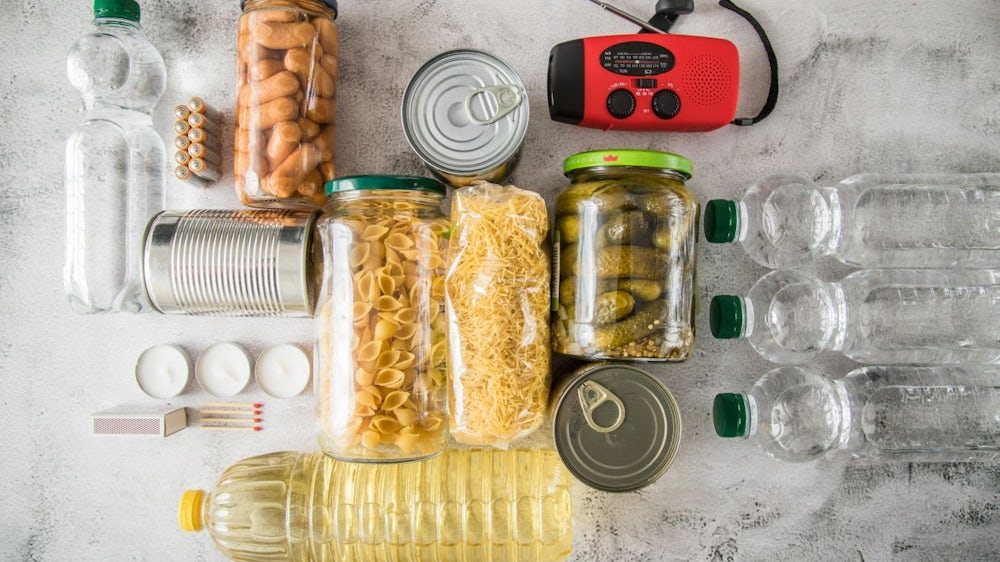
Bottled water and tins of food are becoming part of Britain’s national-security vocabulary again. The government’s emergency-preparedness guidance tells households to keep supplies that can carry them through a power cut, water outage or another disruption lasting several days, while a new public resilience campaign is being prepared for later this year.
The practical advice is straightforward. The official Prepare service recommends bottled water and non-perishable food that does not need cooking, including ready-to-eat tinned meat, fruit or vegetables. For drinking water, it cites a survival minimum of about 2.5 to 3 litres per person per day, while around 10 litres allows more room for basic cooking and hygiene. A tin opener, batteries, a torch, a radio, medicines and first-aid supplies are also part of the household picture.
This is not, by itself, a warning that war is imminent. The official system is deliberately built around an “all hazards” approach: the same cupboard can help during a cyberattack, a blackout, flooding, extreme heat or a hostile-state incident. With much of England in drought this summer, the non-military side of the risk register is hardly theoretical.
What has changed is the strategic frame around that advice. The government’s 2026 Resilience Action Plan implementation report says Britain is accelerating its Home Defence Programme, which aligns civilian and military planning for a period of international hostilities affecting the UK. It also says departments are updating central crisis protocols traditionally known as “War Books” and preparing a national home-defence exercise for 2027.
The National Security Strategy goes further. It says Britain must actively prepare for the possibility of the homeland coming under direct threat, potentially in a wartime scenario. The Strategic Defence Review similarly calls credible national preparation for war, home defence and industrial mobilisation a priority, and says the country should test plans for an armed attack on the UK or NATO allies.
That is the legitimate connection to the possibility of a wider war. Ministers are not telling people that a global conflict is about to begin. They are rebuilding the civilian layer that would be needed if confrontation between major powers spread beyond distant battlefields into cyber systems, energy networks, ports, supply chains and infrastructure at home.
The 2025 National Risk Register shows why a household stock can matter before a missile is ever involved. Its reasonable worst-case scenario for a malicious cyberattack on the electricity system envisages a nationwide power loss with knock-on failures in mobile communications, water, sewage, fuel and gas. Significant power could return within days, but full restoration in a severe case could take a week or longer for some services.
This logic also appears across Europe. The European Commission’s Preparedness Union strategy encourages people to be capable of at least 72 hours of self-sufficiency and links civilian readiness with wider civil-military planning. The aim is partly to keep emergency services free for people who cannot cope alone.
For Britain, the political significance is larger than the contents of an emergency cupboard. For decades, defence policy largely separated the public from the mechanics of national preparedness. The new approach asks households, businesses, councils and infrastructure operators to see resilience as part of deterrence itself.
Water and tins therefore should not be read as a coded prediction of World War Three. They are a modest household response to a security doctrine that now accepts something previous governments often treated as remote: a major international crisis could reach British homes through disrupted networks long before it resembles a conventional battlefield.
80