Society 5 min read By Alice Ashford
Portsmouth landing becomes a policing test for Britain’s south coast
About 140 migrants were brought ashore at Eastney after an unusually western Channel crossing, followed by a night of road blockades, damaged vehicles and a police investigation.
A boat carrying about 140 migrants reached the Hampshire coast on Sunday after an unusually long journey across the Channel, turning Portsmouth into the centre of two connected tests for the British state: how far small-boat routes can shift away from Kent, and how quickly police can contain disorder around an unexpected landing point.
The vessel was first reported during the night of 5 to 6 September to CROSS Jobourg, the French regional maritime rescue centre, west of the Bay of Seine. France’s maritime prefecture said a departure in that area was unusual. French authorities deployed several SNSM rescue vessels, the Abeille Liberté rescue tug and two helicopters to monitor the overcrowded craft and remain ready to intervene. The boat continued towards Britain after its occupants declined assistance while the vessel remained under way.
Once it reached the British side of the Channel, two RNLI boats met the vessel and brought those on board to Portsmouth. HM Coastguard said its response also included lifeboats, a helicopter, an aeroplane and coastal rescue teams. Border Force, Border Security Command, Hampshire Police and South Central Ambulance Service were also involved.
The arrival near Eastney was operationally unusual because the system for receiving people detected on small boats has largely been built around Kent. Those brought ashore in Portsmouth were later transported outside Hampshire for processing in the normal way, with Manston in Kent reported as the expected destination.
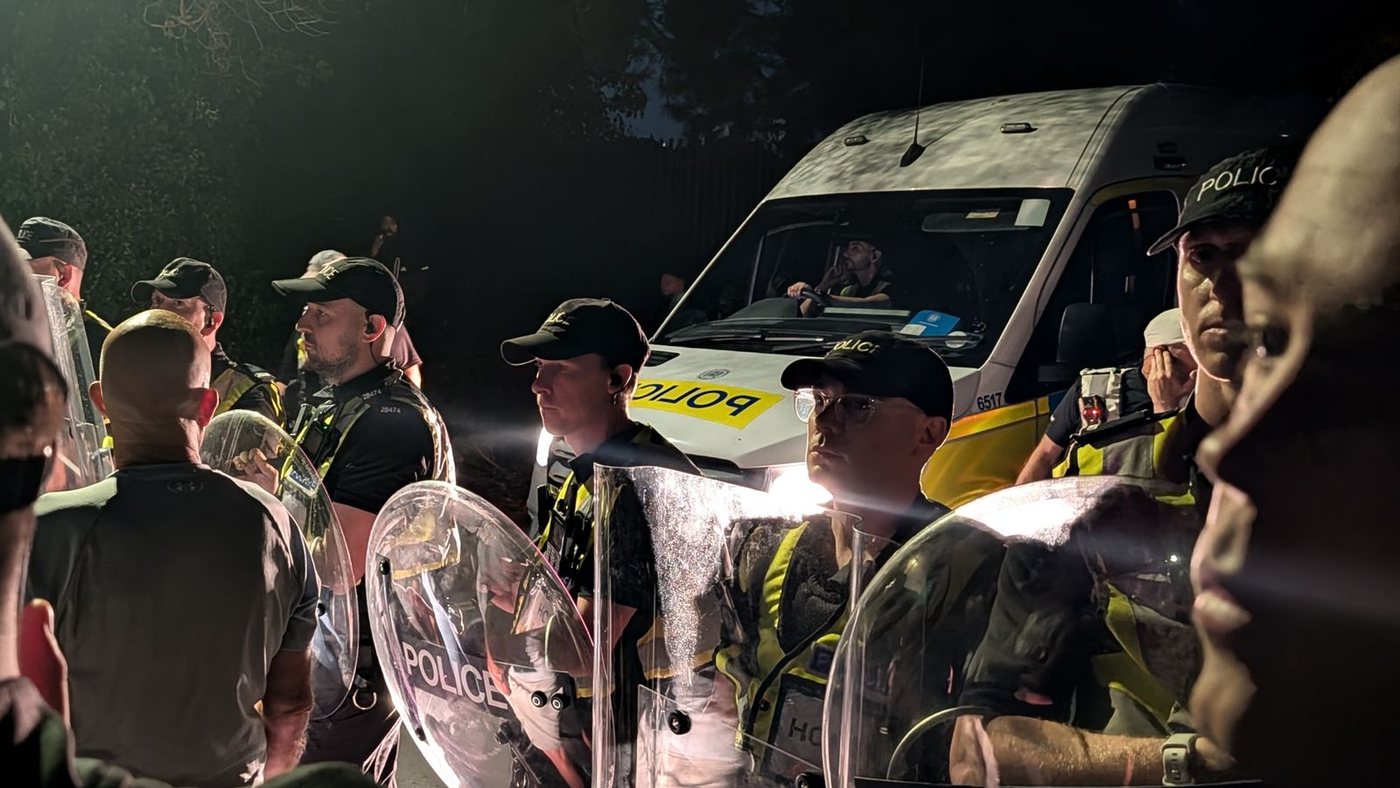
That transfer became the focus of an anti-migrant protest. Hundreds of demonstrators gathered near Eastney, blocked roads and attempted to prevent coaches from leaving. Police formed lines around the vehicles and imposed a dispersal order. Hampshire and Isle of Wight Constabulary later said around 200 demonstrators had been dispersed by about 4am on Monday.
The night did not end as a peaceful blockade. Police said vehicles belonging to the force, Coastguard and Border Force were damaged. A small number of officers were treated at the scene for injuries, none of them serious. The force launched an investigation to identify people responsible for assaults, criminal damage and other possible offences. At the time of its statement, no arrests had been made.
The government condemned the scenes as intimidating and thuggish, while stressing that peaceful protest remains a democratic right. The distinction matters because the event combined a lawful political grievance voiced by many participants with conduct that police say crossed into violence and criminal damage.
The Portsmouth protest also followed a similar demonstration at Dover a day earlier, where masked protesters blocked road access to the port and caused significant disruption. Together, the two events show how the politics of Channel crossings can create an immediate public-order challenge at the same places where border and rescue agencies are trying to move people safely through the system.
For ministers, the harder question is whether Sunday’s route was exceptional or a sign that smuggling networks may try to exploit a wider stretch of the south coast. The French maritime prefecture itself described the departure area as unusual, and landings as far west as Hampshire remain rare. That is not yet evidence of a durable new corridor, but it is enough to expose the limits of a reception system concentrated around Dover and Kent.
Hampshire and Isle of Wight Police and Crime Commissioner Donna Jones said Portsmouth was not equipped to receive and process arrivals in this way and warned that the incident had tied up substantial policing resources. Portsmouth council leader Steve Pitt also questioned the suitability of the Eastney landing point.
The latest official annual data adds an important counterweight to the political temperature. The Home Office recorded 33,374 small-boat arrivals in the year ending June 2026, down 23% from 43,309 a year earlier. The fall is substantial, but it does not remove the operational problem created by a single heavily loaded boat reaching an unexpected part of the coast.
The next test is therefore practical rather than rhetorical. Police will pursue those suspected of offences, while the government and border agencies must decide whether Portsmouth was a one-off emergency landing or a warning that contingency planning needs to extend much further west along the south coast.
97