Politics 5 min read By Arthur Ellington
Labour on course to retain Greater Manchester mayoralty with comfortable lead over Reform
Labour is projected to hold the Greater Manchester mayoralty in the upcoming election to replace Andy Burnham, with a new poll showing a comfortable lead over the Reform party.
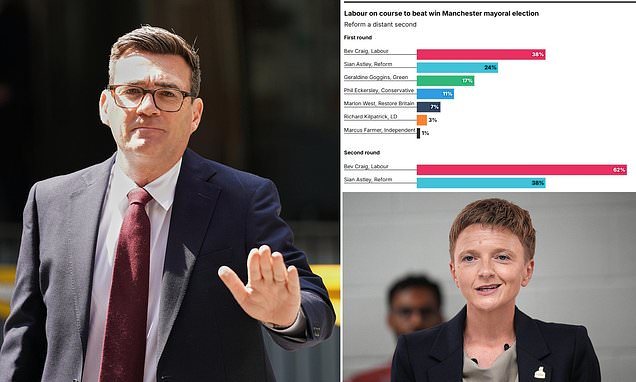
Labour is on course to retain control of the Greater Manchester mayoralty in the election to replace Andy Burnham, according to a new opinion poll that gives the party a comfortable lead over the Reform party. The survey, conducted ahead of the vote to choose Mr Burnham's successor, indicates that Labour's candidate holds a significant advantage, reflecting the party's continued dominance in the region.
The poll, which sampled voters across the ten boroughs of Greater Manchester, shows Labour leading Reform by a double-digit margin, with the Conservative party trailing in third place. This result suggests that despite the national political turbulence and the rise of Reform in other parts of the country, Labour's strong local brand and record under Mr Burnham have insulated the party from a significant electoral challenge. The mayoral election is seen as a key test of Labour's strength in its northern heartlands ahead of a general election.
Andy Burnham, who has served as the directly elected Mayor of Greater Manchester since 2017, is stepping down after two terms. His tenure has been marked by high-profile campaigns on issues such as the cost of living, transport, and housing, as well as a prominent role in national debates on regional devolution. Mr Burnham's popularity in the region is underscored by the poll, which found that more than two-thirds of Greater Manchester residents believe he did a good job leading the region. This strong approval rating is expected to provide a tailwind for Labour's candidate in the upcoming contest.
The Reform party, which has positioned itself as a challenger to the Conservative party on the right, has made inroads in some parts of the country but appears to face an uphill battle in Greater Manchester. The poll suggests that Reform's support is concentrated in specific areas, but it has not yet managed to break through Labour's dominance in the region. The Conservative candidate, meanwhile, is struggling to gain traction, with the party's national polling woes appearing to weigh heavily on its local prospects.
The mayoral election in Greater Manchester is one of several contests taking place across England this year, with voters in other combined authority areas also heading to the polls. The results will be closely watched by all major parties as they gauge the political mood ahead of the next general election. For Labour, retaining the Greater Manchester mayoralty is seen as essential to maintaining momentum and demonstrating that the party can hold onto key positions even as it faces challenges from both the left and the right.
The campaign has focused heavily on local issues, including public transport, housing affordability, and economic development. Labour's candidate has pledged to build on Mr Burnham's legacy, particularly his work on the Bee Network, an integrated transport system, and efforts to tackle homelessness. Reform has sought to tap into voter discontent over immigration and the cost of living, while the Conservatives have emphasised law and order and local investment. However, the poll suggests that these messages have not yet resonated strongly enough to shift the electoral arithmetic.
The election also comes at a time of significant change within the Labour party nationally, with Sir Keir Starmer facing pressure from both the left and the right of the party. A strong result in Greater Manchester would provide a welcome boost for the leadership, while a weaker-than-expected performance could fuel internal criticism. For Reform, the contest represents an opportunity to demonstrate that it can win seats and influence policy, even if it does not take the mayoralty itself.
Voter turnout is expected to be a key factor, with mayoral elections historically attracting lower participation than general elections. Both Labour and Reform are investing heavily in get-out-the-vote operations, particularly in key battleground wards. The outcome will be determined on election day, with the winner set to take office later this year.
101