Politics 7 min read By Bethany Hadley
Andy Burnham becomes Labour leader, vowing to shift Britain leftwards
Andy Burnham has been confirmed as the new leader of the Labour Party, winning overwhelming support from MPs, trade unions, and party branches. In his first speech, he criticised capitalism and promised a return to 1970s-style policies, setting the stage for a significant political shift in the UK.
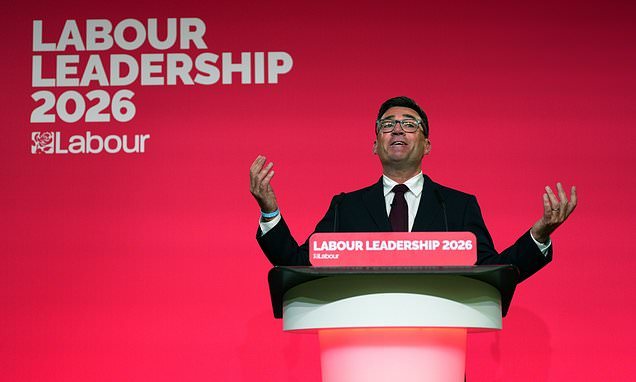
Andy Burnham has been formally confirmed as the leader of the Labour Party, securing the overwhelming backing of MPs, trade unions, and party branches in what has been described as a near-unanimous coronation. The former Greater Manchester mayor will take over as Prime Minister on Monday, succeeding Keir Starmer, who announced his resignation earlier this month. Burnham’s ascent marks a decisive move leftwards for British politics, with the new leader vowing to challenge what he called the «new right» and to restore a vision of the country rooted in the social and economic principles of the 1970s.
In his first speech as Labour leader, delivered at a party event in London, Burnham launched a blistering attack on the «evils of capitalism» and promised to «give hope back» to communities that have been left behind by decades of free-market policies. He argued that the country was «crying out for a new politics» and that his leadership would represent a clean break from the centrist approach of his predecessor. Burnham’s rhetoric drew sharp contrasts with the legacy of Margaret Thatcher, whom he accused of dismantling the social fabric of the nation. «We have lived through an era where profit was placed above people, where the market was treated as a god, and where the state was seen as the enemy,» Burnham said. «That era is over.»
Burnham’s policy platform, outlined in his speech and in subsequent briefings, includes a sweeping programme of nationalisation, higher taxes on corporations and the wealthy, and a massive expansion of public housing and healthcare. He has pledged to renationalise the railways, energy utilities, and water companies, arguing that privatisation has failed consumers and workers alike. The new leader also promised to reverse austerity measures imposed by successive Conservative governments, with plans to increase spending on the National Health Service, education, and social care. Critics have accused Burnham of seeking to return Britain to the economic stagnation of the 1970s, a decade marked by high inflation, industrial unrest, and frequent strikes. However, Burnham dismissed such comparisons, insisting that his vision was about «fairness, security, and community» rather than nostalgia.
The transition of power has been unusually swift. Starmer announced his resignation after a series of poor local election results and internal party rebellions, paving the way for a leadership contest that effectively ended before it began. Burnham’s dominance was such that no other candidate managed to secure the necessary nominations to challenge him, leading to his unopposed election. This has raised concerns among some Labour moderates about the lack of internal debate and the potential for a lurch to the left that could alienate swing voters. Burnham, however, has sought to project unity, reaching out to different wings of the party and promising a «broad church» approach. In his speech, he called for an end to factionalism, saying: «We are one Labour family, and we will govern for the whole country.»
Burnham’s rise to the top of British politics has been a long time in the making. First elected as MP for Makerfield in 2001, he served in several ministerial roles under Tony Blair and Gordon Brown, including as Health Secretary. After Labour’s 2010 election defeat, he ran for the party leadership twice, losing to Ed Miliband and Jeremy Corbyn. He reinvented himself as Mayor of Greater Manchester, a role he held for eight years, where he built a reputation as a pragmatic but passionate advocate for devolution and public services. His tenure as mayor was marked by high-profile clashes with Conservative governments over transport funding, homelessness, and the response to the Covid-19 pandemic. These experiences have shaped his belief that change must come from both the grassroots and the centre of power.
The international reaction to Burnham’s victory has been mixed. European left-wing parties have welcomed his election as a sign that progressive politics can still win, while conservative commentators in the UK and abroad have warned that his policies could damage the economy. Financial markets showed signs of nervousness, with the pound dipping slightly against the dollar and bond yields edging up, as investors weighed the prospect of higher borrowing and state intervention. Burnham sought to reassure business leaders in a separate meeting, emphasising that his government would be «pro-worker and pro-business» and that nationalisation would be carried out «fairly and with proper compensation.» He also stressed that his economic plans would be funded by closing tax loopholes and cracking down on avoidance, rather than by reckless borrowing.
As Burnham prepares to enter Downing Street, the political landscape in Britain is shifting rapidly. The Conservative Party, still reeling from a heavy general election defeat last year, is in the process of selecting a new leader of its own, with several candidates positioning themselves as the standard-bearers of the right. Burnham’s first major test will come with the autumn Budget, where he is expected to outline the full scale of his spending plans. He has also promised a «people’s consultation» on constitutional reform, including the possibility of abolishing the House of Lords and introducing a proportional representation voting system. Whether Burnham can deliver on his ambitious agenda while maintaining economic stability and public support remains to be seen, but his coronation as Labour leader has already set the stage for one of the most dramatic political transformations in modern British history.
101