Economy 4 min read By Bethany Hadley
Deregulated Electricity Markets Raise Household Bills, Analysis Finds
A new analysis concludes that deregulating electricity markets has pushed up prices for residential consumers, challenging the assumption that competition automatically delivers lower bills.
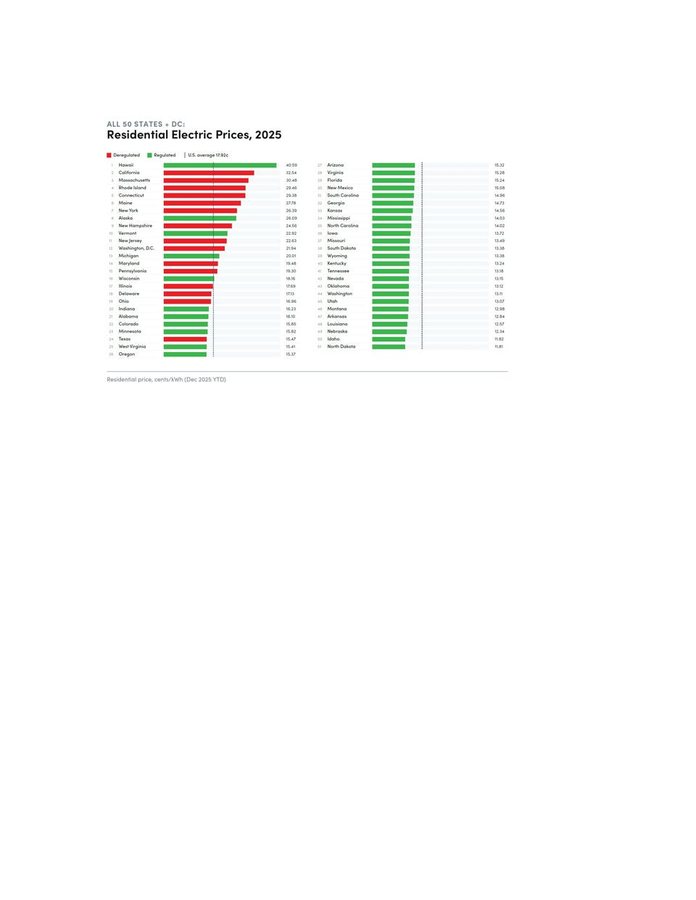
Deregulated electricity markets have led to higher prices for residential consumers, according to a new analysis that challenges the central promise of competition in energy retailing. The finding strikes at the rationale behind a generation of market reforms that were intended to replace regulated monopoly supply with consumer choice and downward pressure on tariffs.
The conclusion matters for households across Britain, where energy bills remain a politically sensitive cost-of-living issue and where the retail market has been reshaped over successive regulatory reviews. If liberalisation has failed to deliver cheaper power for domestic customers, the case for further market-based reform weakens considerably.
The analysis points to a straightforward mechanism. In a deregulated system, generation and retail supply are separated, and consumers are expected to switch suppliers to capture savings. But the costs of marketing, billing, customer acquisition, hedging and retail margin sit on top of the underlying wholesale price. Where competition is imperfect or consumers are inert, those costs are not competed away and are passed through to bills.
Regulated markets, by contrast, tend to bundle supply and distribution under an approved tariff, with the regulator setting or approving the price. That model offers fewer choices but removes the layer of retail costs and margin that competitive suppliers must recover from customers.
The finding is unlikely to settle the debate. Supporters of deregulation argue that competition drives innovation, improves service and creates pressure on inefficient incumbents. They also note that wholesale fuel costs, network charges and government environmental levies are major components of any bill, regardless of market structure.
Critics counter that the promised consumer benefits have not materialised at scale. Switching rates often fall short of expectations, particularly among older, lower-income and rural households. When suppliers fail, as several have in recent years, customers are moved to new providers and the costs of that process can be socialised across the market.
The analysis adds to a broader reassessment of market liberalisation in essential services. Electricity is not a discretionary purchase; households cannot easily opt out, and the consequences of disconnection are severe. That asymmetry gives regulators and governments a strong interest in how prices are set.
For policymakers, the practical question is what follows. Options include tightening retail market rules, increasing transparency on margins and hedging, expanding social tariffs, or returning some functions to regulated supply. Each carries trade-offs between cost, choice, investment and security of supply.
The evidence that deregulation has raised residential rates does not by itself prove that re-regulation would lower them. Network investment, generation mix and global fuel prices remain powerful drivers. But it does undermine the claim that competition is a reliable route to cheaper household electricity, and it shifts the burden of proof onto those who argue for more market exposure in energy retail.
For consumers, the immediate implication is that switching alone is unlikely to solve the affordability problem. For ministers and regulators, the finding sharpens a dilemma that has been building for years: how to keep the lights on and the bills down when the market design itself may be part of the cost.
7