Sports 5 min read By Callum Montgomery
No 10 Demands FIFA Probe After Argentina Players Display Falklands Banner
Downing Street has called on FIFA to investigate Argentina's players after they displayed a banner claiming the Falkland Islands for Argentina following their World Cup victory over England, with a spokesperson declaring 'the World Cup might not be ours but the Falklands are.'
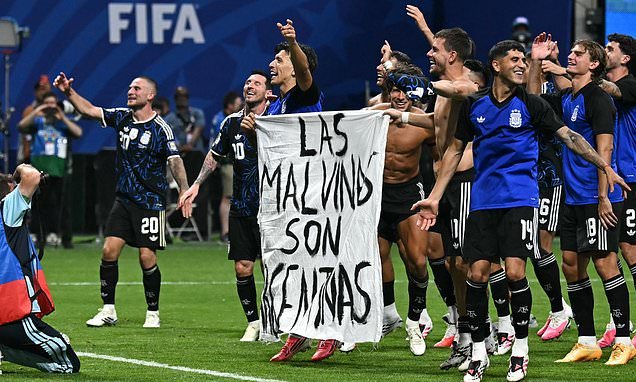
Downing Street has demanded that FIFA investigate Argentina's national football team after players displayed a banner proclaiming the Falkland Islands as Argentine territory following their World Cup victory over England. The incident occurred after Argentina beat England 2-1 on Wednesday night, when players held up a banner reading «Las Malvinas son Argentinas» — Spanish for «The Falkland Islands are Argentinian.»
A spokesperson for Prime Minister Keir Starmer responded defiantly, stating: «The World Cup might not be ours but the Falklands are.» The statement underscored the UK government's unwavering position on the sovereignty of the Falkland Islands, a British Overseas Territory that has been the subject of a long-standing dispute with Argentina. The spokesperson added: «Our commitment to the Falklands will never waver.»
The banner display has sparked a diplomatic row, with the UK government backing calls for FIFA to open a disciplinary investigation. The governing body of world football has rules prohibiting political statements during matches and official events, and the banner was displayed in a post-match setting that could fall under FIFA's jurisdiction. The UK's Minister for the Falklands, Peter Kyle, has been involved in the response, reinforcing the government's stance that the islands are British by the democratic choice of their inhabitants.
The Falkland Islands, known in Argentina as the Malvinas, have been a point of contention since the 1982 Falklands War, in which British forces recaptured the islands after an Argentine invasion. The conflict resulted in the deaths of 255 British servicemen and approximately 650 Argentine soldiers. Since then, the UK has maintained a military presence on the islands, and a 2013 referendum saw 99.8% of Falkland Islanders vote to remain a British Overseas Territory. Argentina, however, continues to claim sovereignty, and the issue remains a sensitive political topic in both countries.
The incident has also drawn attention to broader tensions between the two nations. Earlier this year, Argentina filed a complaint with the United Nations regarding the presence of a Royal Navy warship near the Falklands, describing it as «illegal.» The UK dismissed the complaint, asserting its right to patrol its own territorial waters. The banner controversy adds a new layer to the ongoing dispute, with the UK government using the World Cup stage to reaffirm its position.
Opposition politicians and commentators have also weighed in, with some criticising the Argentine players for politicising a sporting event. The UK government has not yet confirmed whether it will formally submit a complaint to FIFA, but the Prime Minister's spokesperson made clear that the government expects the matter to be taken seriously. FIFA has not issued a public statement on the incident as of yet, but the organisation has previously penalised players and teams for political gestures, including fines and suspensions.
The row comes at a time when the UK is also navigating post-Brexit relations with Argentina, a key trading partner in South America. While the Falklands issue remains a sticking point, both nations have cooperated on issues such as fisheries management and scientific research in the South Atlantic. However, the banner incident threatens to strain those ties, at least in the public sphere.
For the Falkland Islanders, the banner has been a reminder of the ongoing dispute. The islands' government has not issued a formal response, but local representatives have historically welcomed UK support for their right to self-determination. The UK government's firm response is likely to be seen as a reassurance to the islanders that their sovereignty remains a priority for London.
As the story develops, the focus will shift to FIFA's response and whether the Argentine Football Association faces sanctions. The UK government has made its position clear, and the ball is now in FIFA's court. The incident has also reignited debate about the role of politics in sport, with many arguing that football should remain separate from geopolitical disputes. For now, the banner has ensured that the Falklands issue will not be forgotten, even on the world's biggest sporting stage.

85