Sports 5 min read By Alice Ashford
FIFA accused of hypocrisy after England fan’s submarine flag banned but Argentina players display Falklands banner
England fans have accused FIFA of double standards after a supporter’s submarine flag was banned from World Cup stadiums, while Argentina players celebrated with a banner claiming the Falkland Islands.
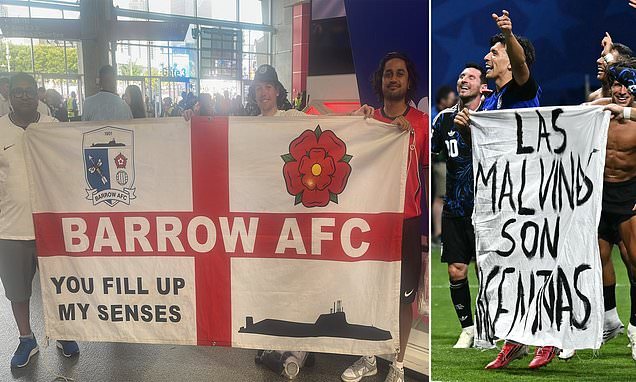
England supporters have voiced anger over what they describe as FIFA hypocrisy, after a shipyard worker was barred from bringing a submarine-themed flag into World Cup stadiums, while Argentina players were allowed to celebrate their semi-final victory over England by displaying a banner that read «Las Malvinas son nuestras» — «The Falklands are ours».
The flag in question, depicting a submarine and bearing the name of a Royal Navy vessel, was deemed by FIFA officials to be a political symbol and was confiscated at the turnstiles. The fan, a shipyard worker from Barrow-in-Furness, had intended to display the flag in support of the England team. He expressed frustration at the inconsistency, pointing out that the Argentina players’ banner — which directly references a long-standing territorial dispute between the two nations — was not only permitted but celebrated on the pitch.
The incident occurred after Argentina’s 2-1 win over England in the World Cup semi-final. Several Argentina players, including Lisandro Martínez and Giovani Lo Celso, were photographed holding the banner in the dressing room. The image quickly circulated on social media, prompting a wave of criticism from British politicians and fans alike.
UK Minister Peter Kyle described the banner as «entirely inappropriate» and called on FIFA to investigate. «I certainly think that FIFA should be looking into this. Absolutely, they should,» Kyle said. He added that the display risked inflaming tensions and was out of place in a sporting context. Downing Street also expressed concern, with a spokesperson stating that the government viewed the banner as «provocative and unnecessary».
The Falkland Islands, known in Spanish as Las Malvinas, have been a source of friction between the UK and Argentina since the 1982 war. The islands remain a British Overseas Territory, but Argentina continues to assert sovereignty. The banner’s appearance at a football match has reignited debate about the role of politics in sport, particularly at a global event like the World Cup.
FIFA’s rules explicitly prohibit political, religious, or discriminatory messages at matches. The governing body has previously sanctioned players and teams for similar infractions. However, in this case, no action has been announced against the Argentina players. Critics argue that the lack of consistency undermines FIFA’s credibility and raises questions about selective enforcement.
England fans have taken to social media to express their dismay, with many sharing images of the banned submarine flag alongside the Argentina banner. One supporter wrote: «So a harmless flag with a submarine is banned, but a banner claiming a British territory is fine? FIFA need to explain themselves.» Another said: «The double standards are staggering. It’s time FIFA applied the same rules to everyone.»
The submarine flag’s owner, who has not been named publicly, said he had used the flag at previous matches without issue. He described the ban as «petty» and accused FIFA of bowing to political pressure. «I’m just a fan who wanted to support my country,» he told reporters. «It’s not fair that Argentina can do that and get away with it.»
FIFA has not yet commented on the Argentina banner or the flag ban. However, the controversy is likely to put pressure on the organisation to clarify its stance on political symbols. Some legal experts have suggested that Argentina could face a fine or a warning, though a points deduction or suspension is considered unlikely.
The incident has also drawn attention to the broader issue of political expression in football. In recent years, FIFA has faced criticism for inconsistent enforcement of its own rules, particularly when it comes to high-profile teams or players. Critics argue that the organisation often turns a blind eye to political gestures when they align with popular sentiment in the host nation or among influential member associations.
For England fans, the episode has left a bitter taste. Many feel that the submarine flag was unfairly singled out, while the Argentina banner was allowed to pass without consequence. The debate shows no signs of fading, with calls for FIFA to issue a formal response growing louder.
As the World Cup continues, the controversy serves as a reminder of the delicate balance between sport and politics. For now, England supporters are left questioning whether the rules are applied equally — or whether some symbols are more acceptable than others.

100