Sports 6 min read By Bethany Hadley
Dortmund’s youth depth passes a serious test at Arsenal
Three teenagers scored in Borussia Dortmund’s 3-2 win over the Premier League champions, offering a practical look at squad depth just before competitive football begins.
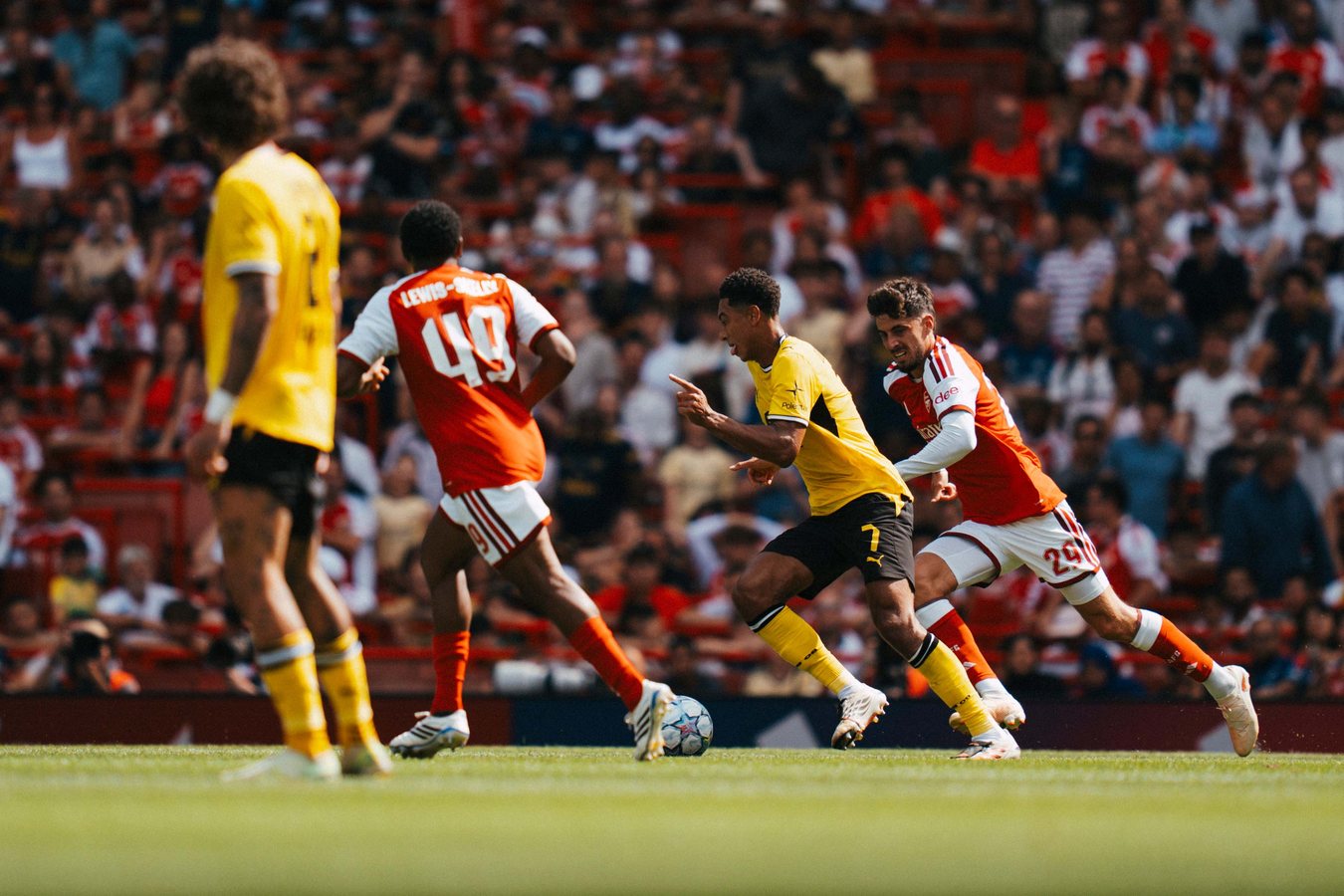
Borussia Dortmund’s 3-2 win at Arsenal can be read as a useful exercise in institutional depth rather than a piece of preseason triumphalism. The German club travelled without several established players and still found all three goals through footballers aged 18 or 19. For a squad about to enter a season with domestic and European demands, that is a meaningful data point. It does not prove readiness for nine months of competition, but it gives management more information about where usable depth may already exist.
Dortmund’s first goal came in the seventh minute. Fabio Silva and Felix Nmecha moved the ball forward quickly before Samuele Inacio, 18, finished into the far corner. Arsenal had begun with greater territorial pressure, but Dortmund’s sequence was efficient: experienced players accelerated the move, a younger forward provided the final action. The goal was a simple example of how a development player becomes useful to a senior side—not by operating separately from the system, but by completing a clearly defined task inside it.
The second goal made the personnel story harder to ignore. Konstantinos Karetsas, also 18, received the ball near the penalty area in the 29th minute and curled a left-footed finish into the corner. This was his first Dortmund appearance after only a few days of training with the team. The fact that he could make an immediate contribution against the reigning Premier League champions does not settle his place in the hierarchy, but it widens Kovač’s options and creates more genuine competition for attacking minutes.
Arsenal’s second-half response tested a different quality. Ethan Nwaneri scored in the 54th minute and shifted momentum toward the home side. Dortmund answered within four minutes when 19-year-old centre-back Joane Gadou scored from a corner sequence. It was Gadou’s first goal for BVB and restored a two-goal cushion at the moment Arsenal looked most likely to take control. For a squad-depth test, that response matters because reserve value is not only technical; it is also the ability to function when the game becomes emotionally unstable.
Viktor Gyökeres converted a penalty in the 69th minute. Arsenal continued to press but could not find a third goal. A separate penalty shootout after the final whistle, requested by Mikel Arteta as part of the exercise, was won by Arsenal and did not alter the 3-2 match result. The distinction matters because the shootout served a training purpose while the competitive sequence of the match had already ended with Dortmund ahead.
The manpower context is central. Dortmund arrived without Emre Can, Nico Schlotterbeck and Mussa Kaba, while Gregor Kobel and Julian Ryerson had only recently returned from their break and did not make the trip. Waldemar Anton and Diant Ramaj were also unavailable. That forced the coaching staff to distribute responsibility across a broader group than it would ordinarily choose for a high-level opponent. The result showed that at least some of those additional options can carry more than ceremonial minutes.
For a club, depth is not simply a sporting luxury. It is operational resilience. A long season creates injuries, workload constraints, suspension risk and performance swings. One friendly cannot prove that Dortmund has solved those problems, and it would be wrong to translate a 3-2 win directly into a financial or market conclusion. But a match in which three young players decide the score against Arsenal gives management evidence that the development pipeline can support first-team demands when the regular hierarchy is disrupted.
The post-match language from Dortmund was appropriately restrained. Niko Kovač said the result was not the main focus and framed the game around progress. Lars Ricken praised the teenagers while stressing the contribution of experienced teammates. That is the more sustainable interpretation: youth does not function as a parallel project; it works when integrated into a structure that gives emerging players clear tasks and support. The club’s challenge is now to determine whether these performances can be repeated rather than simply celebrated.
The timing matters because Dortmund is nearly out of testing space. Roma visits Signal Iduna Park on Aug. 15. Bayern Munich follows on Aug. 22 in the Franz Beckenbauer Supercup, the first competitive match of the season. Arsenal is under even greater immediate pressure, with Manchester City waiting in the Community Shield on Aug. 16. The shift from evaluation to consequence is therefore measured in days, not weeks.
The Emirates Cup will not be remembered as a strategic turning point unless subsequent results give it that meaning. But it offered a concentrated demonstration of two realities: Arsenal still has defensive details to repair before a trophy match, and Dortmund’s young players are closer to being usable first-team resources than a purely developmental label would suggest. In a sport where squad capacity is tested over nine months, that may be the most relevant outcome of the night—and a more valuable conclusion than simply calling a friendly win impressive.

55