Economy 7 min read By Arthur Ellington
Taiwan's defense buildup becomes a structural economic commitment
A planned 16% increase for 2027 would push the broad total above NT$1.1 trillion and deepen state investment in resilience, imported systems and domestic production.
Taiwan’s planned 2027 defense increase is becoming a structural feature of its economy. Reuters reported that the Cabinet intends to propose an approximately 16% rise in the broad NATO-style defense total, taking it above NT$1.1 trillion for the first time. The proposal, due to be unveiled on Aug. 20, will test how far Taipei can turn geopolitical pressure into a stable, multi-year investment framework.
The broad figure includes more than the Ministry of National Defense. Taiwan counts Coast Guard expenditure, veterans’ retirement payments and special defense programs in its NATO-standard measure. In 2026 that total is NT$949.5 billion, equal to 3.32% of GDP, while the MND’s own budget is NT$806 billion. That distinction matters for any assessment of the industrial opportunity created by the increase.
Taiwan’s stated policy is to keep defense spending at no less than 3% of GDP and maintain sustainable growth. A durable floor of that kind changes procurement economics. Suppliers can justify production capacity, training and inventory only when they expect demand to survive beyond one political crisis. At the same time, a larger permanent security bill means fewer public resources are available for other priorities, making execution and value for money more important.
The MND’s 2026–2033 special-budget concept offers a map of the likely investment areas. It includes precision artillery, long-range missiles, air and missile defense, anti-armor weapons, unmanned systems, counter-drone capabilities, sustainment, AI-enabled systems and C5ISR. The ministry also explicitly links the program to strengthening Taiwan’s defense industry and reducing dependence on supply chains exposed to China.
That industrial policy dimension matters because the island faces two competing procurement imperatives. The first is speed: buying mature systems from the United States can fill urgent gaps faster. The second is resilience: domestic production and maintenance reduce reliance on external delivery during a crisis. Taiwan’s legislature in May approved a U.S.-arms framework capped at NT$780 billion, but the MND said the narrower law left out some direct commercial and domestic commissioned projects.
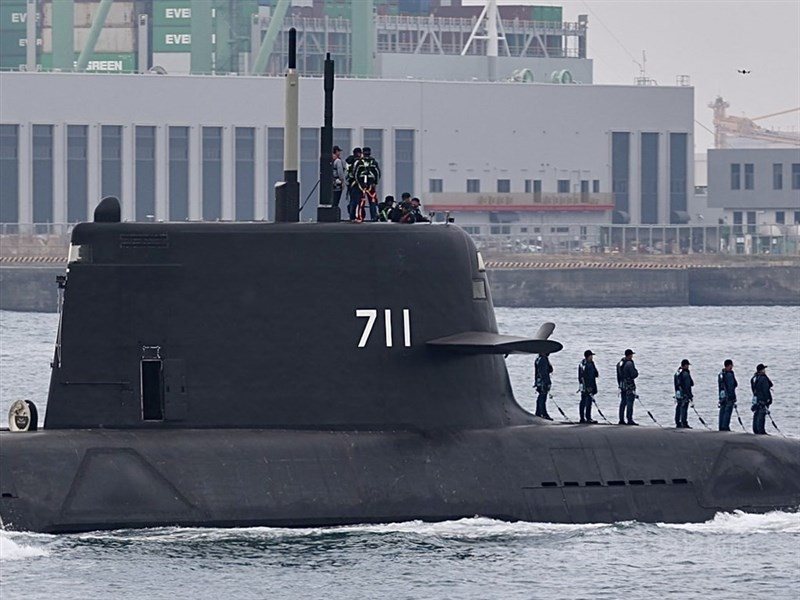
The indigenous submarine program illustrates the long-horizon domestic route. Seven follow-on boats are planned after the Hai Kun prototype, with a total program budget of NT$284.0808 billion running through 2038. Shipbuilding is capital-intensive and technically demanding, but it also creates local capabilities in integration, electronics, testing and maintenance. Those capabilities become strategic assets if external supply routes are disrupted.
Resilience is also changing the definition of efficient spending. Commercial supply chains are optimized to minimize stock and duplication. Defense planning under blockade risk values the opposite qualities: redundancy, spare parts, distributed inventories and multiple communications paths. Taiwan’s budget therefore supports assets that may look underused in peacetime but are intended to preserve operations when normal logistics fail.
The security rationale is persistent military pressure from the People’s Republic of China. Taiwan’s MND says Chinese activity has compressed warning times and raised the need for forces able to absorb disruption. Beijing states that Taiwan is part of China and opposes actions it characterizes as separatist. This political dispute effectively places a risk premium on Taiwan’s infrastructure, logistics and investment planning.
For markets and contractors, the Aug. 20 document will be more useful than the headline number. The key questions are how much of the increase goes to capital investment, how much supports the Coast Guard and veterans, and which programs receive multi-year commitments. Procurement timelines will matter as much as appropriations because delayed systems cannot provide either operational value or predictable revenue.
There is also a governance test. Taiwan’s legislature has already shown that it can reduce or restructure major defense packages. Large multi-year programs require political continuity, transparent contracting and credible oversight if they are to retain public support. A record budget without disciplined execution would increase fiscal cost without producing equivalent deterrent value.
The central economic story is therefore one of conversion. Taiwan is converting a larger share of national output into security spending; the government now has to convert that spending into production capacity, resilient networks and usable military power. If it succeeds, the NT$1.1 trillion threshold will mark not only a budget record but a deeper reorganization of how the island allocates capital in an era of persistent geopolitical risk.
The impact on corporate planning will depend on contract visibility. A supplier is more likely to invest in a new line or train specialized workers if it can see several years of orders rather than a single appropriation. That means the structure of multi-year commitments, not just the 2027 total, will determine whether the defense buildup creates durable domestic capacity. Predictability is itself an economic asset in a sector where certification and qualification can take years.
There is also a concentration risk. If a small number of major programs absorb most of the additional funding, delays in those programs can distort the entire investment cycle. A more diversified portfolio may spread industrial benefits and reduce single-project exposure, but it can also complicate coordination. The Aug. 20 budget will offer the clearest evidence yet of how Taipei is managing that trade-off between scale, speed and resilience.
60