Economy 5 min read By Alice Ashford
Jonas Vingegaard recounts pre-dawn doping test hours before Tour de France crash
Jonas Vingegaard has revealed he was subjected to a surprise anti-doping test at 2 a.m. on the morning of his devastating crash that forced him to abandon the Tour de France during Stage 15.
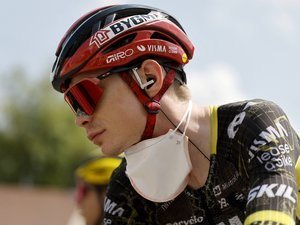
Jonas Vingegaard, the two-time Tour de France champion, has disclosed that he received an unexpected anti-doping control at two o'clock in the morning on the same day he suffered a violent crash that ended his participation in the 2026 edition of the race. The Danish rider, who was forced to abandon the Tour during the 15th stage between Champagnole and the Plateau de Solaison, described the incident as a deeply unsettling experience that disrupted his preparation for one of the most demanding stages of the competition.
Speaking to French media shortly after his withdrawal, Vingegaard stated: «Someone knocked on my door at 2 a.m. to carry out a doping test. It was a surprise control.» The revelation adds a layer of controversy to an already dramatic day for the Visma-Lease a Bike leader, who was considered one of the main contenders for the yellow jersey before his accident. The timing of the test, just hours before a crucial Alpine stage, has raised questions about the impact of such procedures on athletes' performance and safety.
The crash occurred approximately twenty kilometres from the finish line of Stage 15, a gruelling mountain leg that took riders into the heart of the Alps. Vingegaard lost control of his bicycle on a descent, resulting in a heavy fall that left him unable to continue. Medical teams attended to him at the scene before he was transported to a local hospital for further evaluation. The exact nature of his injuries has not been fully disclosed, but the incident marks a premature end to his campaign for a third Tour de France title.
The pre-dawn doping test has sparked debate within the cycling community about the balance between rigorous anti-doping efforts and the welfare of athletes. While anti-doping authorities argue that surprise checks are essential to maintain the integrity of the sport, critics contend that such late-night interventions can disrupt sleep patterns and recovery, potentially increasing the risk of accidents during high-stakes competition. Vingegaard's case is particularly notable because the test occurred on the morning of a stage widely regarded as one of the most challenging in this year's race, featuring steep climbs and technical descents.
Vingegaard's abandonment reshuffles the dynamics of the 2026 Tour de France. The Danish rider had been performing strongly in the mountains and was within striking distance of the overall lead. His absence opens the door for rivals such as Tadej Pogacar, who now faces less competition in the battle for the yellow jersey. The crash also raises concerns about rider safety on descents, a topic that has gained increasing attention in professional cycling following several high-profile accidents in recent years.
The International Cycling Union (UCI) and the Cycling Anti-Doping Foundation (CADF) have not yet commented on the specific circumstances of Vingegaard's test. However, the incident is likely to fuel ongoing discussions about the scheduling of out-of-competition controls, particularly during major tours where athletes are already under significant physical and mental strain. Some team managers have previously called for greater coordination between race organisers and anti-doping bodies to minimise disruptions to riders' routines.
For Vingegaard, the immediate priority is recovery from his injuries. The Visma-Lease a Bike team has not provided a timeline for his return to competition, but early indications suggest that the crash may have long-term implications for his season. The Danish champion's absence from the remainder of the Tour is a significant blow to his team's ambitions and to the spectacle of the race itself, which loses one of its most compelling protagonists.
The broader context of doping controls in professional cycling remains a sensitive topic. While the sport has made considerable progress in cleaning up its image since the dark days of the 1990s and 2000s, occasional controversies continue to surface. Vingegaard has never failed a doping test and has consistently maintained that he competes cleanly. His willingness to speak publicly about the late-night control suggests a desire for transparency, even as questions linger about the appropriateness of such measures on race days.
As the Tour de France continues without him, Vingegaard's story serves as a reminder of the fine margins that define success and failure in elite sport. A knock on the door at two in the morning, followed by a crash on a mountain descent, has abruptly halted what promised to be a thrilling contest for cycling's most prestigious prize.
86