Technology 4 min read By Callum Montgomery
Russia’s Rassvet Is an Industrial Test, Not a Starlink Clone
A few hundred satellites could provide persistent regional coverage, but Russia’s real hurdle is manufacturing and launch cadence rather than orbital physics.
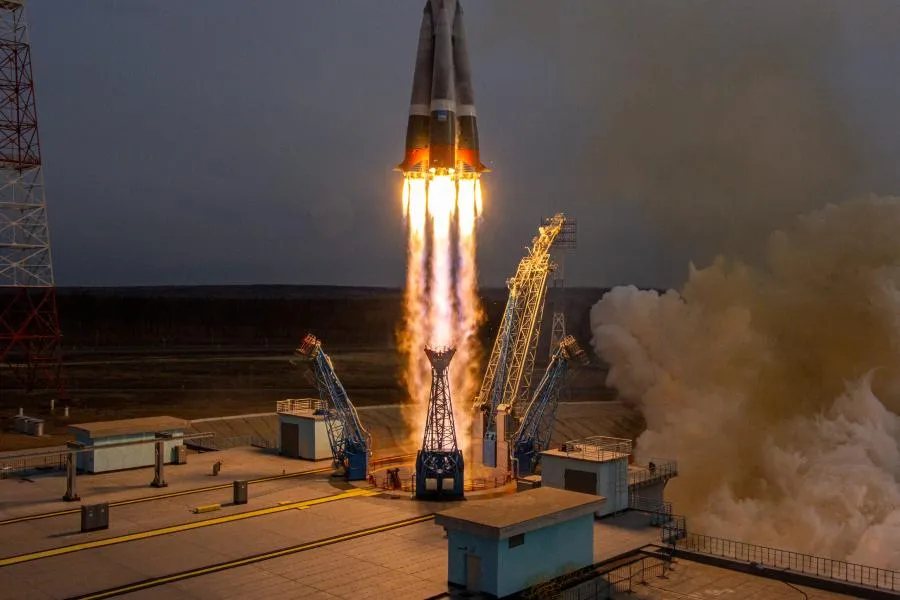
Russia’s Rassvet project is easier to misunderstand if it is measured only against Starlink’s fleet size. The more useful test is whether Russia can manufacture and launch enough spacecraft to create a reliable sovereign communications layer over the theatre it cares about.
Science Official’s original analysis estimates that roughly 37 Rassvet-related spacecraft may now be in orbit, assuming the six early prototypes remain operational alongside the surviving March batch and the 16 spacecraft launched in July.
That is nowhere near a mature broadband constellation. Yet it is enough to show that Bureau 1440 has crossed the line from demonstrations to serial deployment.
The physics is relatively forgiving. At an operating altitude of about 800 kilometres, a satellite completes an orbit in roughly 101 minutes. It cannot hover over Ukraine, so continuous service depends on many satellites moving through multiple orbital planes and handing users from one spacecraft to the next.
A simplified 12-plane constellation with about 250 satellites can maintain continuous geometric visibility over Kyiv at a 25-degree minimum elevation. That does not tell us the network’s true capacity, but it demonstrates that Russia does not need a 10,000-satellite fleet to build a militarily relevant regional system.
The industrial arithmetic is harder. Public Russian targets call for 156 spacecraft in 2026, 292 in 2027 and 318 in 2028. From an estimated 37 today, reaching the 2026 figure would require roughly eight more launches carrying 16 satellites each before year-end — about one every 18 days.
That cadence would be demanding for any programme. For Russia it must be viewed against the broader Soyuz launch system. United Engine Corporation said its engines supported 13 Soyuz-2 launches during all of 2025 across Russian launch sites. Rassvet would therefore consume a significant share of national launch capacity if the published 2026 target were taken literally.
Manufacturing may be an even tighter constraint. The programme needs repeatable satellite buses, payload electronics, propulsion, laser crosslinks, antennas, software, terminals and test infrastructure. The first serial batch already lost one satellite after it failed to raise its orbit. A constellation factory must replace failures while still expanding the fleet.
This is why claims that Russia is “ahead of schedule” deserve caution. The public schedule actually slipped: a mass launch expected in late 2025 flew in March 2026, while the next batch did not launch until July.
For Western planners, the danger lies elsewhere. Russia does not need parity with Starlink’s aggregate capacity to gain strategic value. A few hundred well-phased satellites could support command posts, large drones, naval platforms and resilient backup links. That would reduce dependence on terrestrial infrastructure and create a network whose nodes are constantly moving.
Rassvet is therefore best seen as a defence-industrial scaling test. If Bureau 1440 can turn its current batch launches into a repeatable monthly rhythm, the programme could become operationally important well before it becomes commercially comparable with Starlink.
52