
Business 5 min read By Callum Montgomery
Monte Paschi weighs escape routes from Intesa’s €30.6bn bid
MPS is using stronger earnings and capital to argue that independence has economic value as Intesa’s offer would split the bank’s branch network and brand.
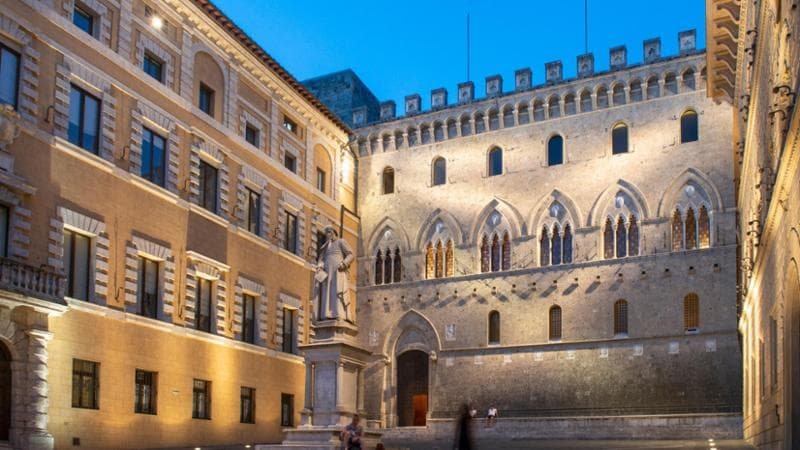
Monte dei Paschi di Siena is trying to turn a balance-sheet recovery into bargaining power. Chief executive Luigi Lovaglio says the bank is examining strategic options while seeking to preserve its integrity and independence, challenging the industrial case for Intesa Sanpaolo’s unsolicited €30.6 billion offer.
The bid is unusually consequential because it is not simply a proposal to fold one lender into another. Intesa has already designed a substantial carve-out intended to address competition concerns. That makes the question facing MPS shareholders broader than whether the headline premium is adequate: they must also decide whether the value of the bank as an integrated institution is greater than the value offered through a transaction that would divide its network.
Intesa announced its proposal on 8 June. It offers 16 newly issued Intesa shares for every 10 MPS shares tendered, plus €1 in cash for each MPS share. At the time of announcement, the package represented a 12.5 per cent premium to MPS’s official closing price on 5 June. Intesa has presented the deal as a way to strengthen its European leadership in wealth management, protection and advisory services.
The antitrust solution is central to the economics. Intesa signed a binding agreement with Unipol Assicurazioni under which a separate banking entity containing the MPS brand, about 635 branches and most of the central structures required to operate independently would be sold for roughly €3 billion to €3.5 billion. Intesa would retain Mediobanca, the Mediobanca brand and about 625 MPS branches.
For Lovaglio, that structure gives substance to the language of integrity. MPS would not merely lose control; the organisation would be divided between two owners. His broader argument is that consolidation can be healthy when it creates stronger institutions without eroding competition across the banking system. The implication is that a bigger national champion is not automatically a better outcome if it reduces the number of meaningful competitors.
MPS can make that case from a stronger financial position than it could have only a few years ago. The bank reported second-quarter net profit of €610.2 million, up from €479.4 million a year earlier on restated figures. Its Common Equity Tier 1 ratio rose to 16.3 per cent. It also increased 2026 guidance for pre-tax profit to €3.6 billion.
That capital matters because it expands the bank’s strategic menu. Lovaglio has said the buffer can support growth, shareholder distributions and strategic opportunities. In takeover-defence terms, the most credible alternative to a bidder is not rhetoric but a convincing plan to create value independently or through another transaction.
MPS also controls an economically significant asset through Mediobanca: a stake of about 13.3 per cent in Assicurazioni Generali. Lovaglio has characterised that position as useful rather than indispensable and acknowledged outside interest. In a contest over capital allocation, such a holding could remain a strategic lever or become a source of funds, depending on which route maximises long-term value.
One potential route has already become more complicated. Banco BPM ended preliminary talks over a combination with MPS in early August. The breakdown reduced the number of visible alternatives to Intesa, but it did not close the door on future corporate moves. MPS continues to signal that it will assess opportunities if they emerge.
The wider relevance for European banking is clear. Years of higher profitability have left several lenders with enough capital to pursue scale, while regulators remain sensitive to domestic concentration. The Italian contest therefore sits at the intersection of shareholder returns, antitrust policy and the strategic question of how many large banks a national market can sustain.
The next phase will depend on shareholder judgement and regulatory approvals. Intesa must demonstrate that its premium and projected synergies outweigh the costs of dismantling MPS as an integrated institution. MPS, in turn, must show that independence is not simply an emotional attachment to a historic name but a financially superior use of capital.
50