Business 4 min read By Callum Montgomery
A $26m refusal exposes the land risk behind hyperscale data centres
Mason County rezoned 2,080 acres for a large data campus, but two landowners kept 534 acres despite offers far above ordinary farm values.
The data-centre boom has an obvious capital story: chips, power contracts, substations and billions of dollars of construction. Mason County, Kentucky, offers a less glamorous constraint — land assembly.
Ida Huddleston and her daughter Delsia Bare refused offers exceeding $26m for 534 acres sought in connection with a hyperscale data-centre project outside Maysville. Huddleston was offered $60,000 an acre for 71 acres; Bare was offered $48,000 an acre for 463. The bid represented a substantial premium to ordinary agricultural values reported locally, yet it failed.
The reason was partly non-financial and partly informational. The family's wider farm is about 1,200 acres and has been held across generations for more than two centuries. It remains a working agricultural property. PEOPLE also reports that Bare's late husband is buried there. Selling would monetise the acreage but permanently unwind a family enterprise and landscape.
The information problem mattered because the women initially signed. Bare told PEOPLE that fear of eminent domain pushed the family towards a contract. After legal advice established that the private developer could not simply force this sale, they withdrew. Their reservation price effectively moved from very high to undefined.
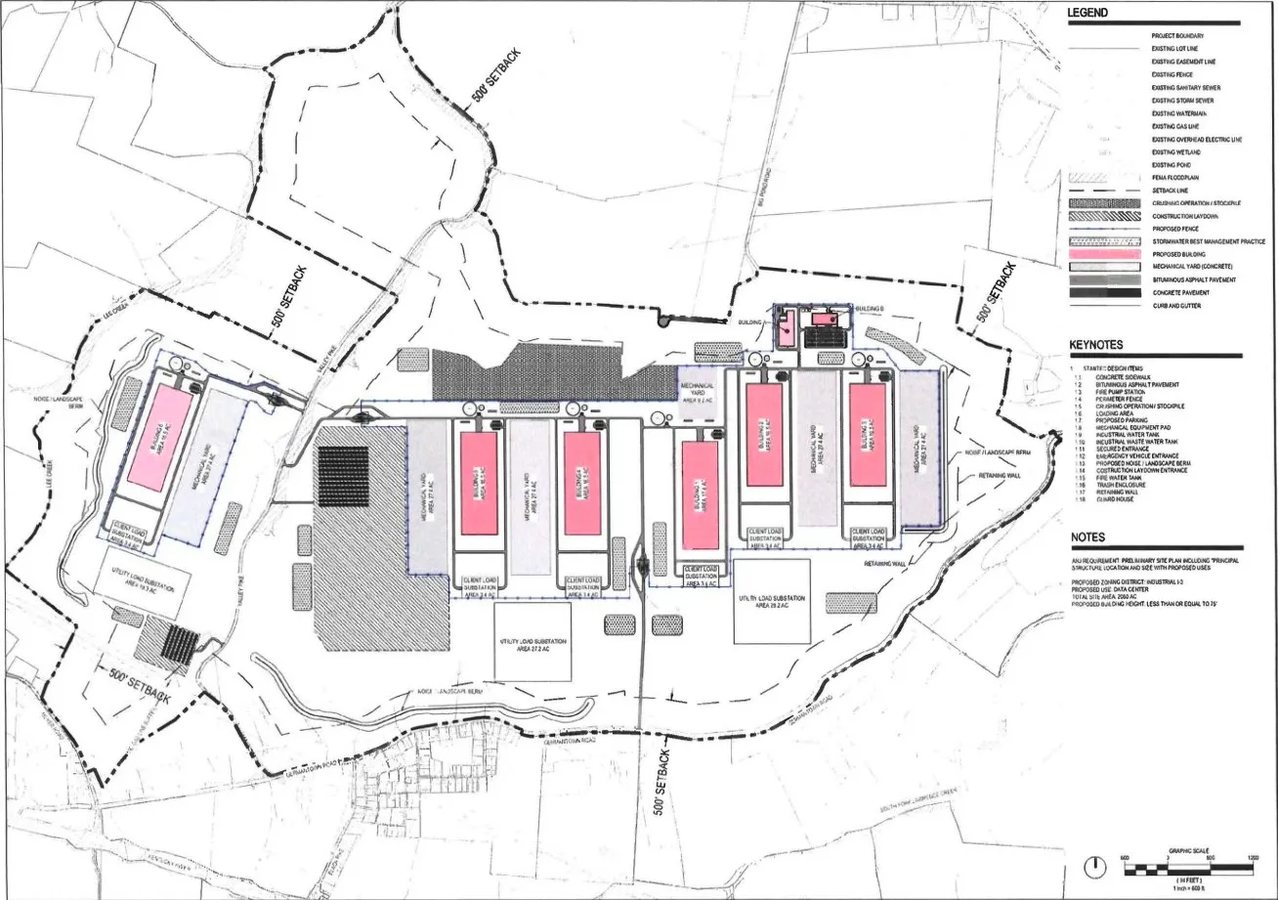
The developer's response demonstrates why hyperscale site strategies seek large footprints rather than a single irreplaceable parcel. On 22 May, Mason County approved the rezoning of 28 properties totalling roughly 2,080 acres for rural industrial use. The project therefore has a path forward without the Huddleston-Bare acreage. The end user remained publicly undisclosed in July.
Local officials present an economic-development case: about 400 permanent jobs, more than 1,500 construction jobs and developer-funded road, water, sewer and electricity infrastructure. The opposition sees a different risk allocation. Residents are being asked to accept industrial land conversion and long-term infrastructure effects while the ultimate operator has not been named publicly.
Power is the wider strategic constraint. Lawrence Berkeley National Laboratory's June 2026 update estimates that data centres could account for 9.5% to 15.3% of US electricity consumption by 2030, with an 11.8% reference case. That national estimate does not determine the Mason County load, but it explains why large sites near energy infrastructure have become valuable and politically sensitive.
Water is more site-specific. Huddleston and Bare fear pressure on local supplies, but the effect cannot be inferred from the word 'data centre' alone. US Department of Energy guidance shows that water consumption varies materially by cooling design: evaporative cooling towers consume water, while other strategies and efficiency measures can reduce it. The project would need to be judged on its actual engineering.
We Are Mason County is pursuing legal challenges to the approval process. That creates a remaining planning risk even after rezoning. The unnamed developer also still controls the final investment decision.
For investors and local governments, the lesson is that land premium is not a universal solvent. Large infrastructure projects require consent, legal clarity and political durability alongside capital. Mason County has supplied most of the acreage and the zoning, but two owners have shown that a cheque can lose bargaining power when the seller values continuity more than liquidity.
65